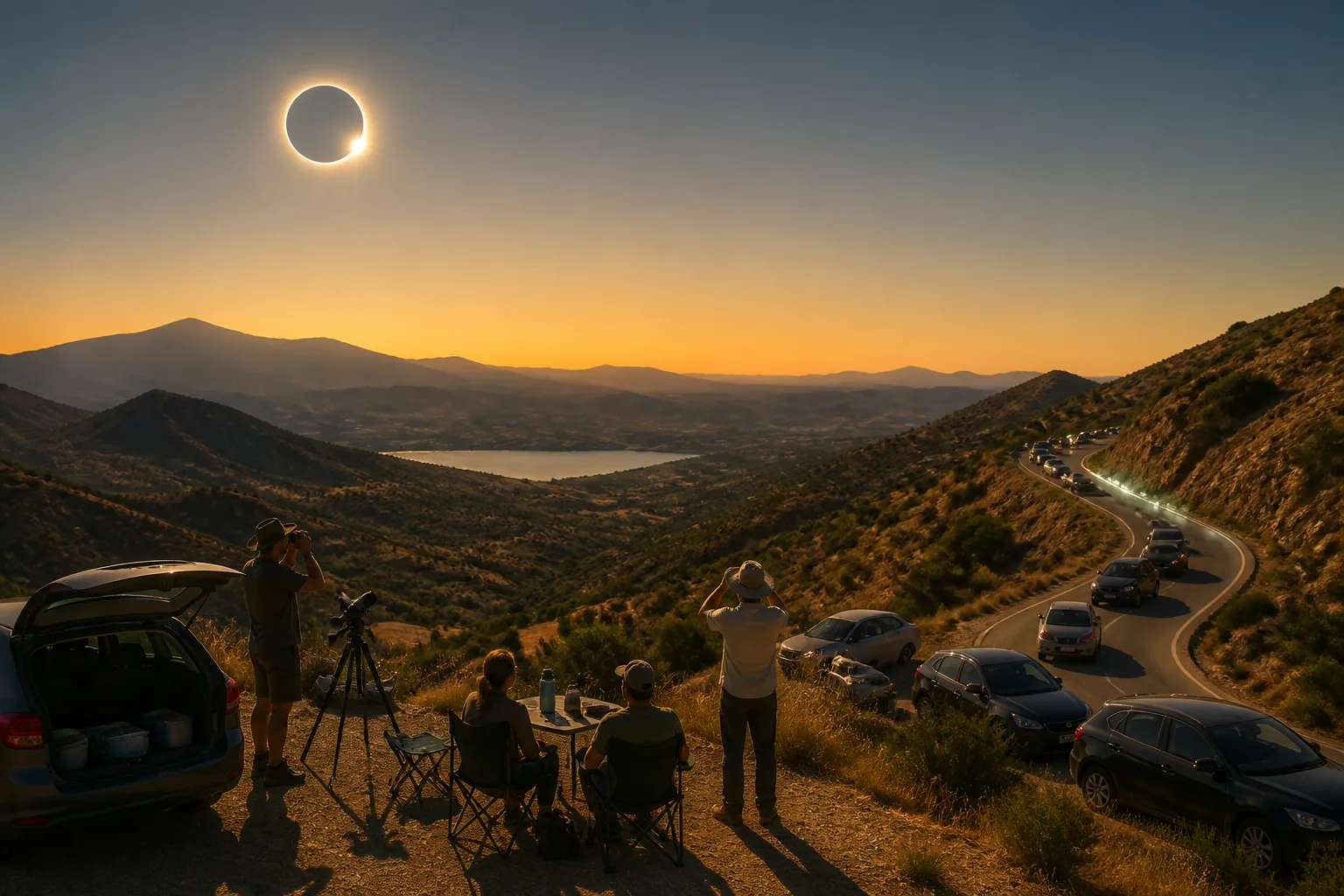
Andalusia will see its first total solar eclipse in more than a century in August next year. It will be the second in a series of three eclipses taking place between 2026 and 2028. The first will occur this summer, on August 12, and will be partial in the region. In 2027, the eclipse will be total in part of Andalusia; in 2028, it will be annular.
Sunday, August 2, offers local managers, institutions and the public an opportunity to assess conditions in advance and anticipate logistical challenges for next year’s eclipse, which is expected to attract international attention. The 2027 eclipse will be total in 115 municipalities in the provinces of Cádiz, Málaga, Granada and Almería. The assessment will help identify spaces able to accommodate visitors, potential problem areas, and measures needed to manage traffic, prevent crowding and ensure safety.
The exercise is not intended to reproduce the Sun’s exact position. Instead, it will assess local conditions during one of the busiest periods of the summer tourist season. For administrations and town councils, it will provide a practical picture of travel patterns, use of public spaces and the capacity of major access routes. The findings are intended to inform preparations for the total eclipse in 2027, when the summer timing could draw thousands of people to Andalusia’s best viewing locations.
The assessment will consider how long it takes to reach and leave viewing areas; the condition of access routes and roads and the availability of parking; whether safe places are available for people to remain comfortably for several hours; and the availability of shade, water, basic services and medical assistance. It will also consider public transport options and possible restrictions imposed by authorities. Heat will be a key factor. Organisers recommend planning for sun protection and hydration, with particular attention to older people and children. Viewers must use approved, undamaged eclipse glasses throughout the observation and must never look directly at the Sun or use optical instruments without specific filters.
### Assessment day and mirror day
Sunday’s exercise should not be confused with so-called mirror days, which are complementary tests, according to Alejandro Sánchez de Miguel, a researcher at the Institute of Astrophysics of Andalusia (IAA-CSIC). On mirror days, such as the one held on May 7 and the one planned for May 10, 2027, the Sun is in nearly the same position as during the eclipse. An assessment day instead reproduces the event’s tourist and logistical context. A mirror day helps establish the Sun’s height and orientation in the sky and identify visual obstructions, such as buildings or trees, at specific locations.
### An exceptional phenomenon
The August 2, 2027 eclipse will be total in parts of Andalusia, Ceuta and Melilla, and partial elsewhere in Spain, according to the National Geographic Institute (IGN) and NASA. In Spain, the path of totality will cross the area around the Strait of Gibraltar and include cities such as Cádiz and Málaga, as well as coastal towns in Granada and Almería.
The eclipse will occur in the morning, at around 10:45 to 10:50 a.m., when the Sun will be higher above the horizon than during the 2026 and 2028 eclipses. The IGN says the eclipse will begin over the Atlantic at 9:30 a.m. mainland Spain and Balearic Islands time and end over the Indian Ocean at 2:43 p.m. Its maximum will occur in Egypt, where totality will last 6 minutes and 23 seconds, making it one of the longest total eclipses of the century.
The 115 Andalusian municipalities where the eclipse will be total are:
**Almería:** Adra, Almería, Balanegra, Berja, Dalías, El Ejido, La Mojonera, Níjar, Roquetas de Mar and Vícar.
**Cádiz:** Alcalá de los Gazules, Algar, Algeciras, Arcos de la Frontera, Barbate, Benalup-Casas Viejas, Benaocaz, Castellar de la Frontera, Chiclana de la Frontera, Chipiona, Conil de la Frontera, Cádiz, El Bosque, El Puerto de Santa María, Grazalema, Jerez de la Frontera, Jimena de la Frontera, La Línea de la Concepción, Los Barrios, Medina Sidonia, Paterna de Rivera, Puerto Real, Rota, San Fernando, San José del Valle, San Martín del Tesorillo, San Roque, Tarifa, Ubrique, Vejer de la Frontera and Villaluenga del Rosario.
**Granada:** Albondón, Albuñol, Almuñécar, Gualchos, Jete, Lújar, Molvízar, Motril, Otívar, Polopos, Rubite, Salobreña, Sorvilán, Torrenueva Costa, Vélez de Benaudalla and Ítrabo.
**Málaga:** Algarrobo, Algatocín, Alhaurín de la Torre, Alhaurín el Grande, Almogía, Almáchar, Alozaina, Alpandeire, Atajate, Benadalid, Benahavís, Benalauría, Benalmádena, Benamocarra, Benaoján, Benarrabá, Cartajima, Casarabonela, Casares, Cortes de la Frontera, Coín, Cártama, El Burgo, Estepona, Faraján, Frigiliana, Fuengirola, Gaucín, Genalguacil, Guaro, Igualeja, Istán, Iznate, Jimera de Líbar, Jubrique, Júzcar, Macharaviaya, Manilva, Marbella, Mijas, Moclinejo, Monda, Montejaque, Málaga, Nerja, Ojén, Parauta, Pizarra, Pujerra, Rincón de la Victoria, Ronda, Sayalonga, Tolox, Torremolinos, Torrox, Totalán, Vélez-Málaga and Yunquera.