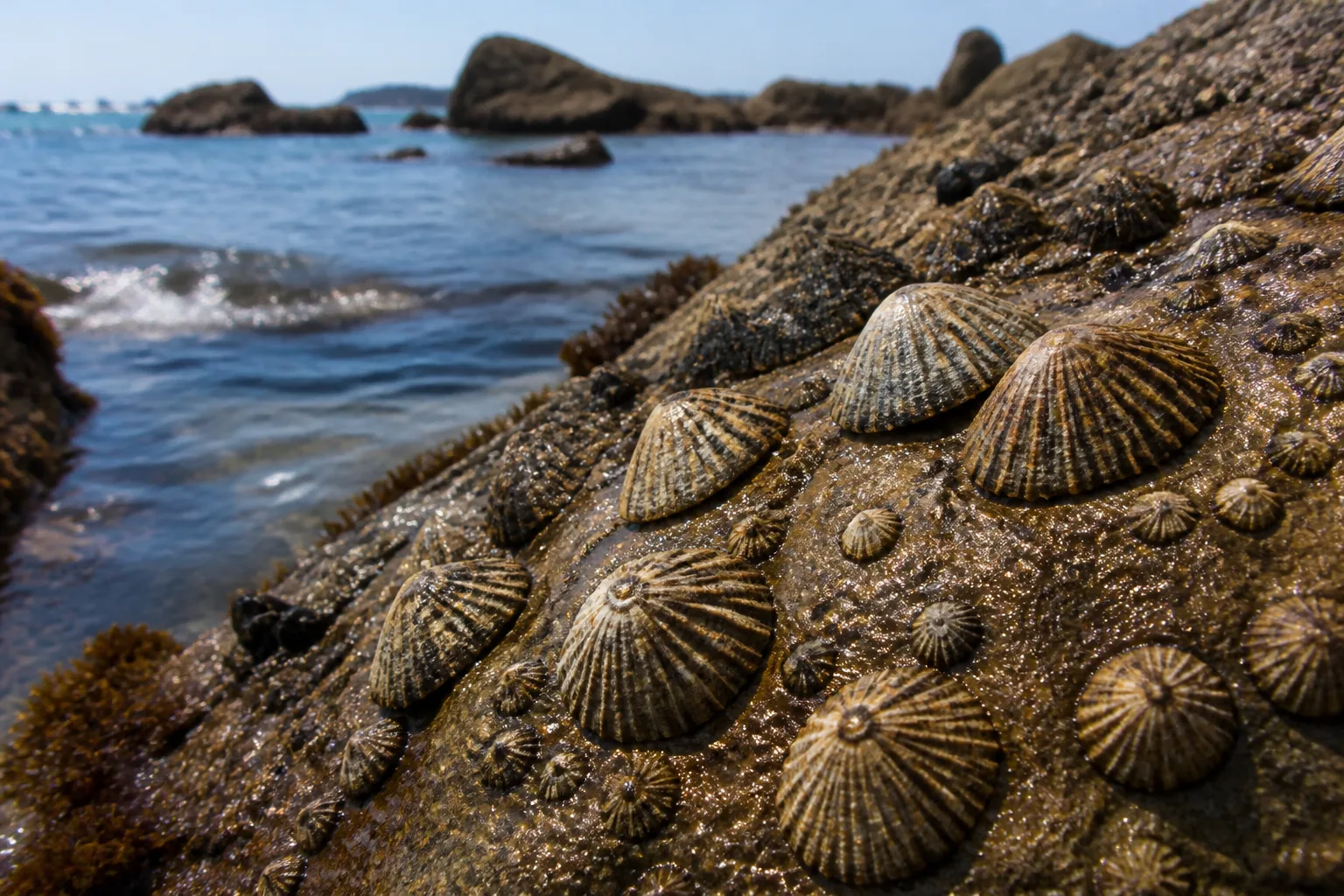
The Andalusian regional government began monitoring the ferruginous limpet, a marine gastropod found only in the Mediterranean, in 2010, when just 1,800 specimens were recorded across Andalusia. A 2025 census estimated the adult population along the Andalusian coast at around 65,000, compared with more than 30,000 in 2022.
The figures come from monitoring conducted under the Marine Environment Programme of the Regional Ministry of Sustainability and the Environment. The work tracks the species’ numbers and distribution and the arrival of new individuals. Despite the overall increase, the population remains vulnerable. The rise is linked in part to recruitment events recorded since 2014 and to conservation measures for the species and its habitat, in place since the programme began in 2004.
Ferruginous limpets (Patella ferruginea) live on rocks near the Mediterranean shoreline, where they are exposed to tides, waves, coastal changes and human pressure. They can grow to 10 centimetres and have thick radial ridges on their shells. The species is classified as endangered and has a fragmented distribution along the Andalusian coast.
Monitoring indicates that Andalusian populations do not rely solely on larvae arriving from Ceuta and the Rock of Gibraltar. The population in Algeciras Bay can reproduce locally. More than 22,000 limpets have been recorded there, and every monitored location in the area has a density of more than one individual per linear metre of coast. Cádiz and Málaga account for 70% of the recruitment recorded in Andalusia. In Málaga, more than half of the counted limpets are juveniles.
The large number of juveniles does not necessarily translate into a corresponding increase in adults: monitoring points to high mortality during the early stages of life. For that reason, surveys also assess size and the proportions of juveniles and adults. Adult density and recruitment both fell slightly in 2025 from their 2024 peaks, although the overall trend and the estimated adult population remain positive.
The highest densities recorded in the 2025 regional census were in Cádiz: 5.2 limpets per linear metre at Sotogrande and five per metre at Isla de Las Palomas. Outside Cádiz, Puerto Banús in western Málaga had the highest recorded density, at 1.75 per metre. Cádiz holds 62% of Andalusia’s population, concentrated in Algeciras Bay and the Strait of Gibraltar, an area with heavy maritime traffic.
This concentration makes the species vulnerable to events such as an oil spill, which could affect a large share of the regional population. Around 50% of individuals are found in protected natural areas, but populations remain exposed to coastal changes and high mortality among juveniles.