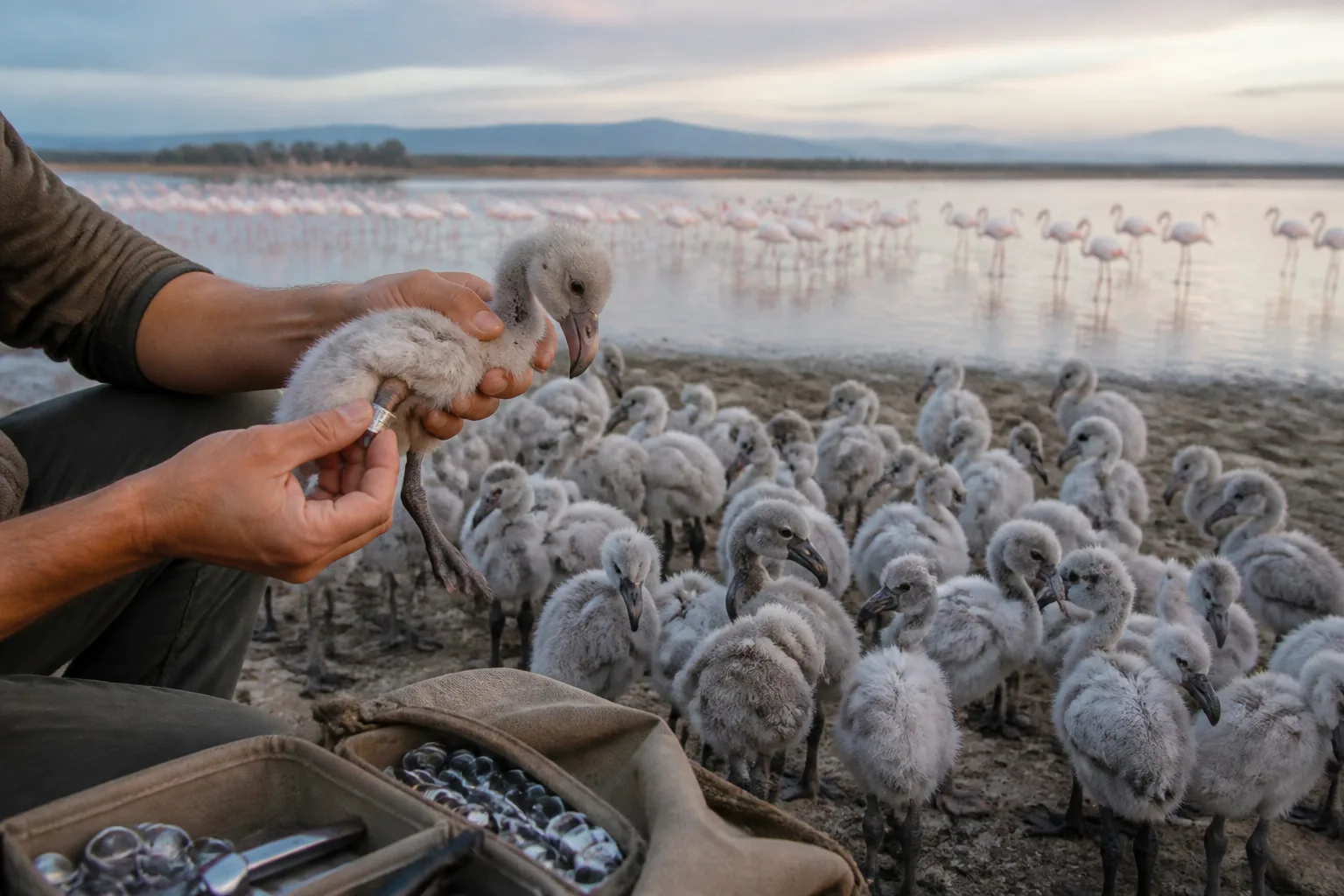
Andalusia’s regional minister for Sustainability and the Environment, Fina Martínez, took part in the ringing of common flamingo (Phoenicopterus roseus) chicks at the Fuente de Piedra Lagoon Nature Reserve in Málaga. This year, 600 birds were marked out of 15,500 chicks counted, the third-highest total recorded at the wetland. More than 400 people joined the operation, coordinated by the regional government and carried out in four hours before dawn.
The ringing programme began at Fuente de Piedra in 1986 and reached its 40th anniversary in 2026. By the end of 2025, 20,777 chicks had been fitted with rings bearing codes that can be read from a distance. The 600 marked this year bring the cumulative total to more than 21,000. Since monitoring of the colony began in 1984, 269,200 chicks have hatched at the lagoon.
Participants included veterinarians, researchers and technical staff from the regional government and the Andalusian Environment and Water Agency (Amaya), as well as professionals from Córdoba Zoo, which is helping care for and rehabilitate any birds injured during capture. Civil Protection members, local residents and volunteers also took part. The chicks were captured, identified, measured, weighed and fitted with rings before being released. Biological samples were also collected.
Individual ringing allows researchers to follow the species without recapturing birds and gather information on breeding behaviour, migration routes and use of wetlands. More than 70% of birds ringed at Fuente de Piedra have been recorded at least once. Over 40 years, more than 167,000 sightings have been logged in 23 countries, from Guinea-Bissau to Cyprus. More than 30% of sightings have been made again at the lagoon, reflecting the flamingos’ strong tendency to return to the same breeding site.
The 2025–2026 hydrological year had recorded 663 millimetres of rainfall, the fourth-highest total in the area in the past half-century. The lagoon reached a maximum depth of 101 centimetres in March, compared with levels that in most years do not exceed 50 centimetres. The water conditions helped provide isolation for nesting areas. Flamingos began nesting on Senra Island in the second half of February and later occupied the Canchones del Suroeste area. The colony totalled 35,177 pairs, the highest since monitoring began in 1984.
Fuente de Piedra lagoon has been recognised as a Ramsar Wetland of International Importance since 1983. It is also a nature reserve and part of the Natura 2000 network as both a Special Area of Conservation and a Special Protection Area for Birds.