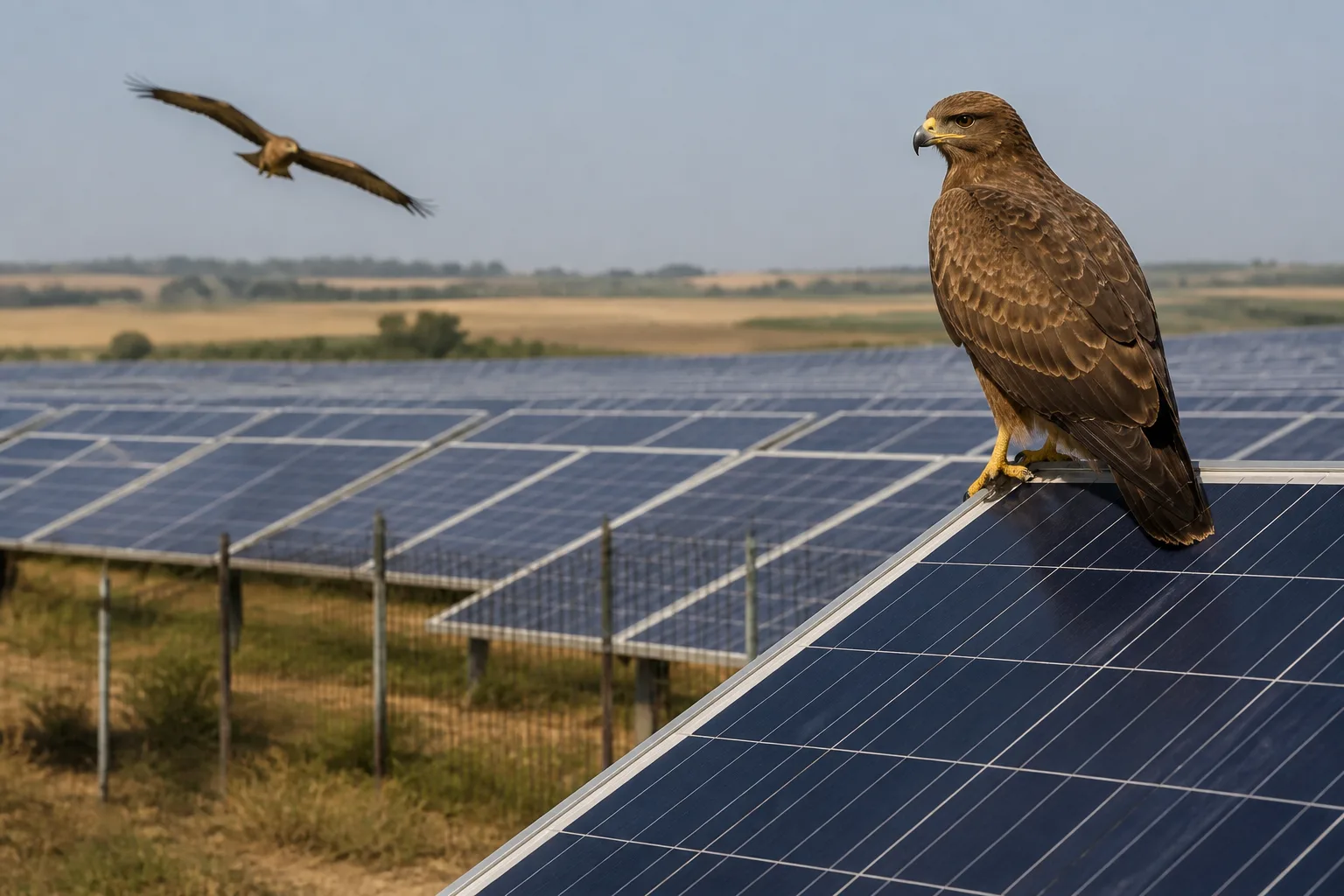
A study led by the University of Málaga (UMA), with funding from the Andalusian Regional Government’s Ministry of University, Industry, Energy and Innovation, found that six species of birds of prey regularly used a photovoltaic solar plant, mainly to rest, survey the area and hunt. Researchers monitored the facility for two and a half years, beginning when it was built. The findings could help incorporate wildlife conservation criteria into the planning and management of future facilities.
Large photovoltaic plants are a pillar of the energy transition, but questions remain about their effects on biodiversity. The research team said there is little scientific literature based on field sampling of specific sites. Working with BioGea Consultores, the University of Extremadura and Ofitecma Marbella, the researchers studied the presence and behaviour of raptors at a facility covering almost 300 hectares in the Guadalquivir Valley.
The study, “Raptors Using a Solar Photovoltaic Facility in Southern Spain,” was published in the Journal of Raptor Research. Researchers monitored a solar plant in Seville province through regular observations from fixed points and walks inside the site. They recorded six species. The common buzzard and common kestrel were the most frequently observed, while the black kite was the most numerous.
The team also examined how the birds used the plant. They most often perched on panels, posts and fences to look for prey or rest. The facility is in a cereal-growing area where other perches are scarce. Hunting activity is restricted within the site, offering some protection to prey. Researchers observed rabbits, hares, partridges and small mammals, which may in turn attract raptors. Several species were documented hunting among the solar modules. Some soaring birds also used warm air currents rising from the panels to gain height with little wing movement.
The researchers reported no raptors killed or injured in collisions with panels, supporting structures or fencing during the monitoring period. They cautioned, however, that the results cannot automatically be extended to all solar plants. The team does not know what the raptor community was like before construction, how nearby facilities might affect it, or what the effects may be in the medium or long term.
The researchers say similar studies should be carried out where new plants are planned, alongside long-term monitoring. They plan to expand their work across Andalusia to examine how the growth of photovoltaic facilities affects steppe birds, which are closely associated with the open agricultural landscapes where such installations are commonly built.
The research forms part of the Complementary R&D&I Plan in Biodiversity, funded by the Andalusian Regional Government’s Ministry of University, Industry, Energy and Innovation, Spain’s Ministry of Science and Innovation, and the European Union’s Next Generation EU funds.