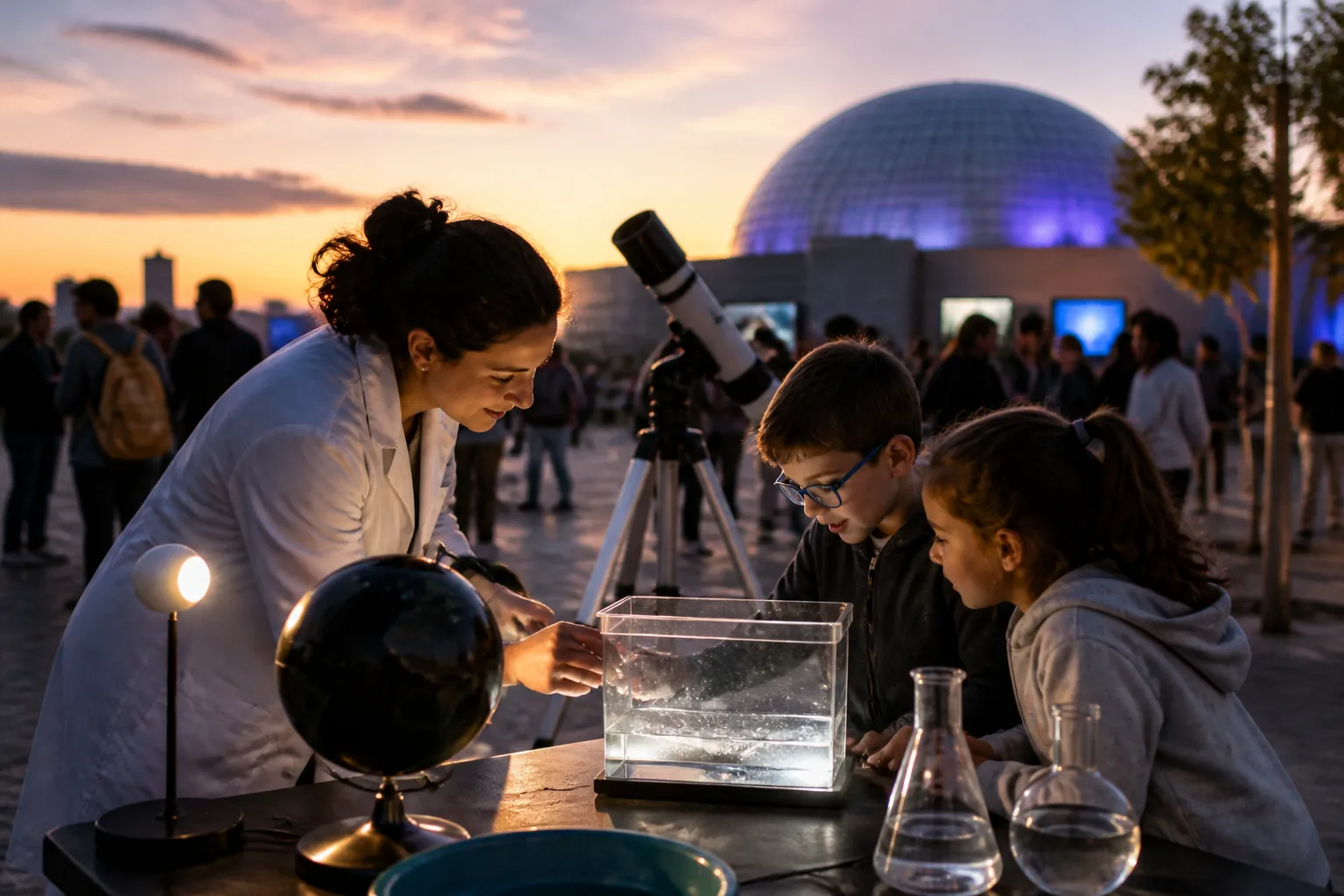
This archive item, dated 24 September 2026, reported that the Regional Ministry of University, Industry, Energy and Innovation was supporting another edition of the European Researchers’ Night in Andalusia. The event was scheduled for 25 September, with 3,647 researchers taking part and 950 science outreach activities planned across the region’s eight provinces. Organisers expected more than 80,000 people to attend the events.
Coordinated by the Descubre Foundation, the event was marking its 15th edition in Andalusia in 2026. Launched in the region in 2012, it aims to explain the benefits of scientific progress and its relevance to everyday life, encourage young people’s interest in science, and promote research as a career. Activities include experiments, workshops, demonstrations, scientific routes, theatre and monologues. Around 77 activities were scheduled to take place during September ahead of the main event, and 47 were to be held online.
Planned venues included Rambla Federico García Lorca in Almería; Plaza del Rey in San Fernando, Cádiz; the gardens and courtyards of the University of Córdoba’s rectorate; Paseo del Salón in Granada; Avenida Bulevar de las Artes y las Ciencias in Huelva; Plaza de El Corte Inglés in Jaén; Paseo del Parque in Málaga; and the Casa de la Ciencia-CSIC Museum in Seville. Events were generally due to begin in the early afternoon and continue until close to midnight.
Eclipses and water were the two themes for the 2026 programme. Eclipse-related activities were linked to the “Trio of Eclipses,” three consecutive phenomena visible from Spain between 2026 and 2028, with Andalusia set to have a prominent role in 2027. Water-focused activities were to address its importance in health, food, energy, technology, the environment, land and culture. The Andalusian event was also set to collaborate with European Researchers’ Nights in Sweden, Malta, the United Kingdom, Italy, Ireland, Portugal and Croatia.
The programme was jointly designed by Andalusia’s nine public universities, the Progreso y Salud Public Foundation, the IMGEMA-Royal Botanic Garden of Córdoba and the Spanish National Research Council (CSIC). Radio and Television of Andalusia and the Andalusian Institute for Agricultural, Fisheries, Food and Organic Production Research and Training (IFAPA) were strategic partners. European Researchers’ Night is promoted by the European Commission through the Marie Skłodowska-Curie Actions under the Horizon Europe programme, and has been held simultaneously in nearly 400 European cities since 2005.