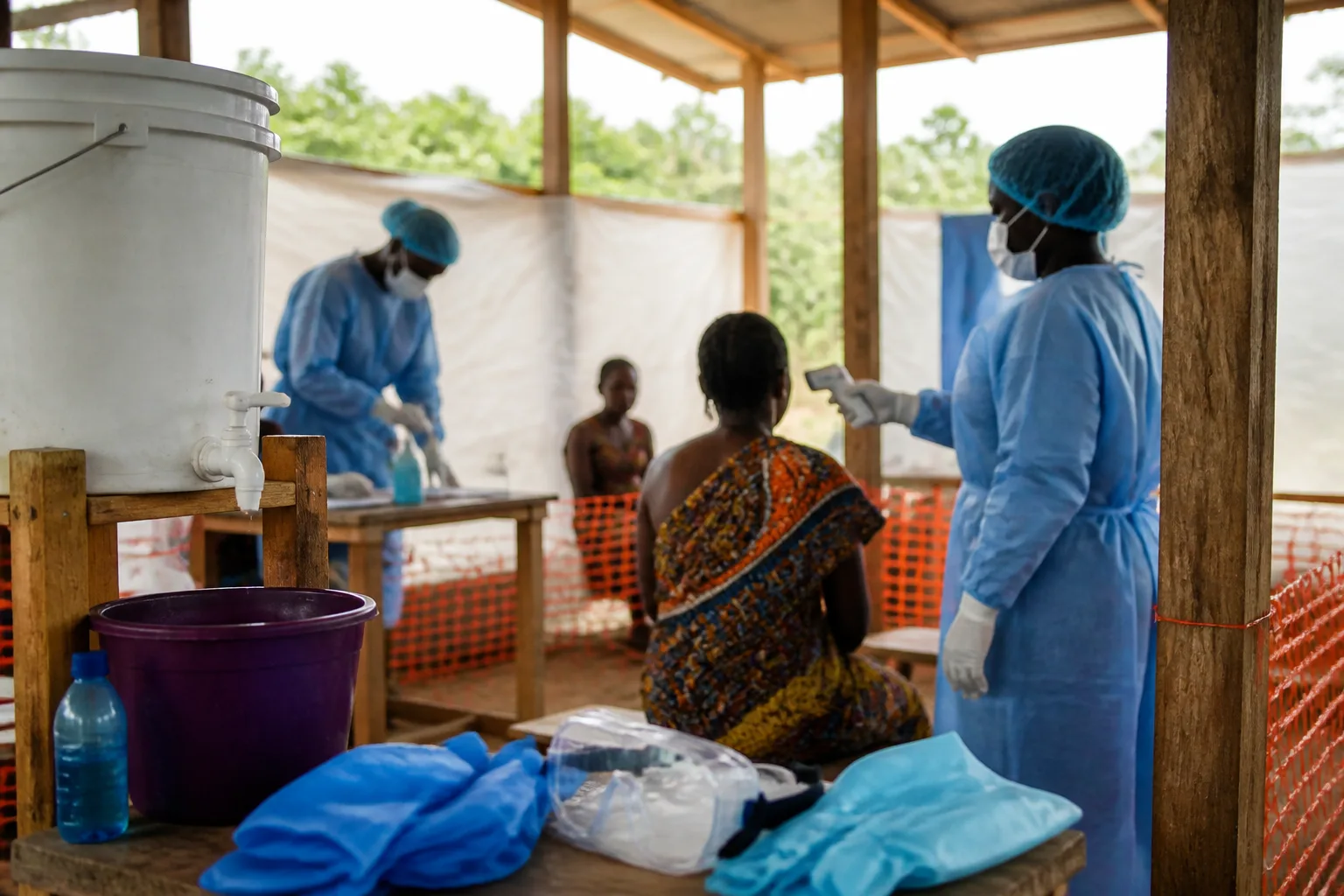
Professionals from the Northern Málaga Health Area, part of the Andalusian Health Service (SAS), took part with Doctors of the World in a health intervention in South Kivu province in the Democratic Republic of the Congo. The aim was to strengthen health services’ ability to respond to the Ebola outbreak and other epidemic diseases affecting the population. The mission is taking place in the Miti-Muherca and Katana health zones, amid significant structural and humanitarian challenges.
The professionals’ work focuses on infection prevention and control, and on strengthening triage procedures at 14 health centres to help identify and isolate possible suspected Ebola cases. The task is particularly challenging because of shortages of both personal protective equipment and healthcare staff. During their stay, the team also trained staff responsible for triage. The strategy uses a highly sensitive algorithm to identify patients with sudden or severe fever, while taking into account that malaria remains one of the leading causes of fever-related death in the area.
As a training aid, the team prepared a ten-point guide to infection prevention and control, setting out the ten essential actions to take during triage. It is intended to help healthcare staff understand and correctly apply procedures, with attention not only to the use of protective equipment but also to the importance of staff actions during patient care.
The mission also includes work related to the cholera epidemic in the Katana health zone. In addition to supporting cholera treatment centres, Doctors of the World is helping residents access safe drinking water through 20 chlorination points. Access to water is a particular problem at rural health facilities. During a visit to Lugendo health centre, the team found that the cholera treatment unit did not have enough water to prepare rehydration salts for admitted patients. Water had to be brought to the centre as an emergency measure.
One current measure is to increase the centre’s water storage capacity by installing new tanks to meet its needs until the community’s next scheduled water delivery. Rainwater collection is also being considered.
The intervention is taking place amid several concurrent public health problems. Alongside Ebola and cholera, South Kivu is facing a measles epidemic that has prompted a childhood vaccination campaign. Information relayed from the field indicates that weekly measles incidence has been falling for several weeks since the campaign ended.
The work also requires ongoing coordination with health-zone authorities, other non-governmental organisations and managers of the referral hospital.