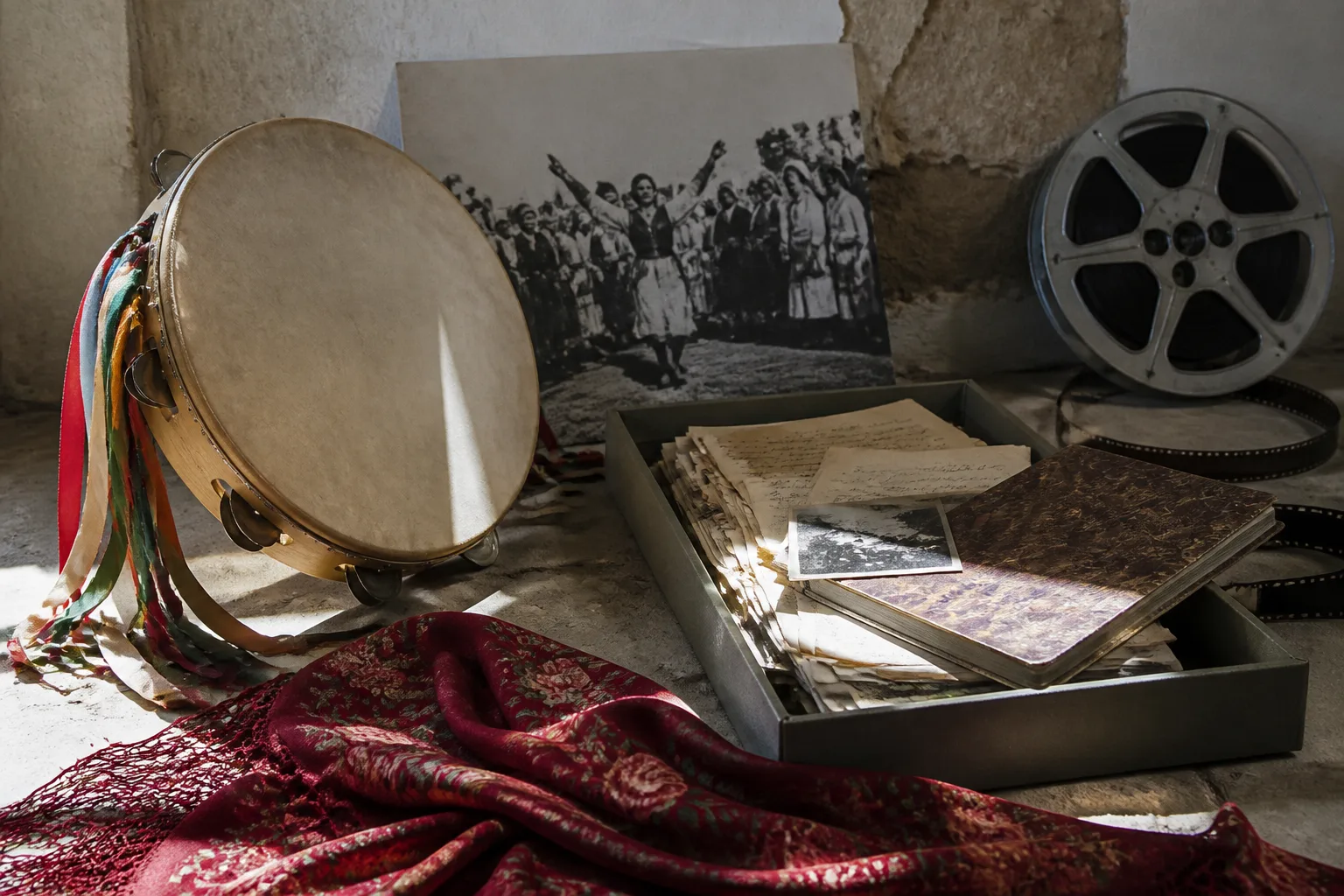
The Centre for Contemporary Creation of Andalusia (C3A), part of the Andalusian Regional Government’s Department of Culture, Historical Heritage and Sport, presented *The Tarantula’s Bite: South and Folklore*, an exhibition exploring the continuing relevance of Italian anthropologist Ernesto de Martino’s (1908–1965) ideas and their relationship to contemporary art produced in the south. Curated by Lluís Alexandre Casanovas Blanco, the exhibition was on view in Gallery T4 until 28 March 2027.
The exhibition draws on de Martino’s research in southern Italy during the 1950s, informed by the writings of philosopher Antonio Gramsci and the work of poet and painter Carlo Levi, who was exiled to Lucania in 1935. The display includes original material from de Martino’s research alongside recent works and new productions by young Andalusian artists.
One focus is de Martino’s study of tarantism, a supposed psychological condition popularly attributed to a tarantula bite. It was said to leave those affected in convulsions or a trance, with music and dance rituals associated with a cure. In his 1961 study *The Land of Remorse*, de Martino drew on historical sources documenting similar phenomena in Spain. The exhibition includes case files and medical treatises recording instances of tarantism in the Iberian Peninsula in the 18th and 19th centuries, as well as records dating to the mid-20th century.
The anthropologist’s work was documented in images, films and sound recordings, which informed Italian artistic and filmmaking practice of the time and continue to engage new generations of artists. The exhibition places these materials alongside films, photographs, documents and contemporary works. Audiovisual works include those by filmmakers Lino Del Fra, Giuseppe Ferrara, Cecilia Mangini and Gianfranco Mingozzi, among others, documenting tarantism, funeral laments, harvest rituals and therapeutic practices.
The exhibition also presents films by Andalusian filmmakers from the late 1970s and early 1980s that examined pilgrimages, religious rituals and other forms of popular culture. These include Fernando Ruiz Vergara’s *Rocío* (1980), with research and screenplay by Ana Vila, and *Tierras de Málaga* (1979), by the Málaga Film Cooperative. The films record aspects of Andalusian society in that historical period.
New works by young Andalusian artists offer contemporary perspectives on folklore. Featured artists include María Alcaide (Huelva, 1992), María Rosa Aránega (Almería, 1995), Mateo Chica (Madrid, 1998) and Manuel Zapata Vázquez (Seville, 1991); Chica and Zapata Vázquez were commissioned to produce works specifically for the exhibition. The show also includes works by Universidad Popular del Mediodía, a project of La Madraza – Centre for Contemporary Culture at the University of Granada, based at Casa de Porras in the Albaicín.
Materials in the exhibition come from institutions and archives including the National Archive, Madrid’s Municipal Historical Library, the Marqués de Valdecilla Historical Library at the Complutense University of Madrid, the Carlo Levi Foundation, the Franco Pinna Archive, the Bologna Film Archive, the Andalusian Film Library and the Central Institute for Intangible Heritage of Italy’s Ministry of Culture in Rome.