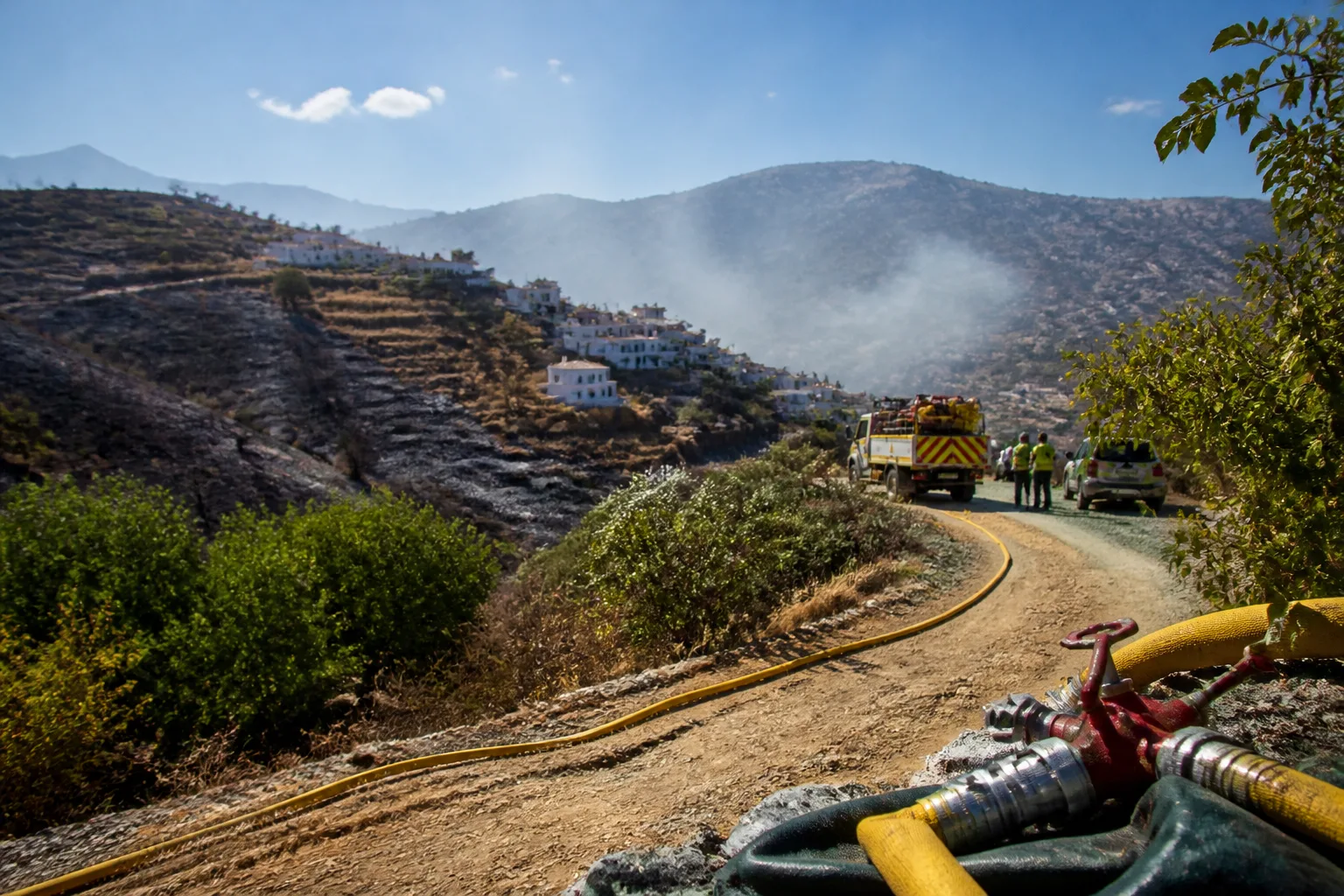
Antonio Sanz, regional minister for the Presidency, Health and Emergencies and director of Andalusia’s Forest Fire Emergency Plan (Plan Infoca), deactivated its emergency phase, operational situation 1, at 10:18 a.m. on Saturday, 18 July. The phase had been activated at 2:52 p.m. on Friday after a wildfire broke out in the Barranco de la Fuente area of Árchez, in Málaga province’s Axarquía region.
The fire was declared stabilised at 11:40 p.m. on Friday. On Saturday morning, emergency commanders authorised the safe, phased return home of 162 people temporarily evacuated as a precaution from scattered residential areas in Árchez, Cómpeta and Canillas de Albaida. About 20 people spent the night in hotels in the area. A shelter-in-place order for the municipality of Cómpeta was lifted at 8:50 p.m. on Friday; its 4,415 residents had been under the measure for several hours.
The Forest Fire Emergency Plan remains active in pre-emergency phase, operational situation 0. The municipalities of Árchez and Canillas de Albaida activated their local emergency plans on Friday.
The fire started shortly before 12:40 p.m. on Friday. The first of more than 50 calls reporting the blaze was received by the 1-1-2 emergency number. The fire was in steep grassland near the town’s recycling centre. The emergency coordination centre alerted Infoca’s provincial operations centre, the Andalusian Emergency Group, Málaga Provincial Council fire crews, the Guardia Civil, local police, the regional unit of the National Police, the Red Cross, the 061 emergency health service, and Civil Protection volunteer groups from Cómpeta, Canillas de Albaida and Algarrobo.
The Andalusian Emergency Group set up an advanced command post to coordinate the response. Patricia Navarro, the Junta’s representative in Málaga, visited the site to oversee coordination and attend meetings with the response teams.
After the fire was stabilised, Infoca kept 65 ground personnel, five fire engines, a mobile weather and communications unit, and a medical unit on duty overnight. A light transport and firefighting helicopter was expected to join during the morning. Other provincial aircraft remained available if needed. Since the fire began, the response had included 10 aircraft—two light helicopters, two medium-heavy helicopters, one command helicopter, four air tankers and one coordination aircraft—as well as 80 ground personnel, two fire engines, a command team and a medical unit. More than 220 personnel from the various response services had worked at the scene since Friday afternoon.