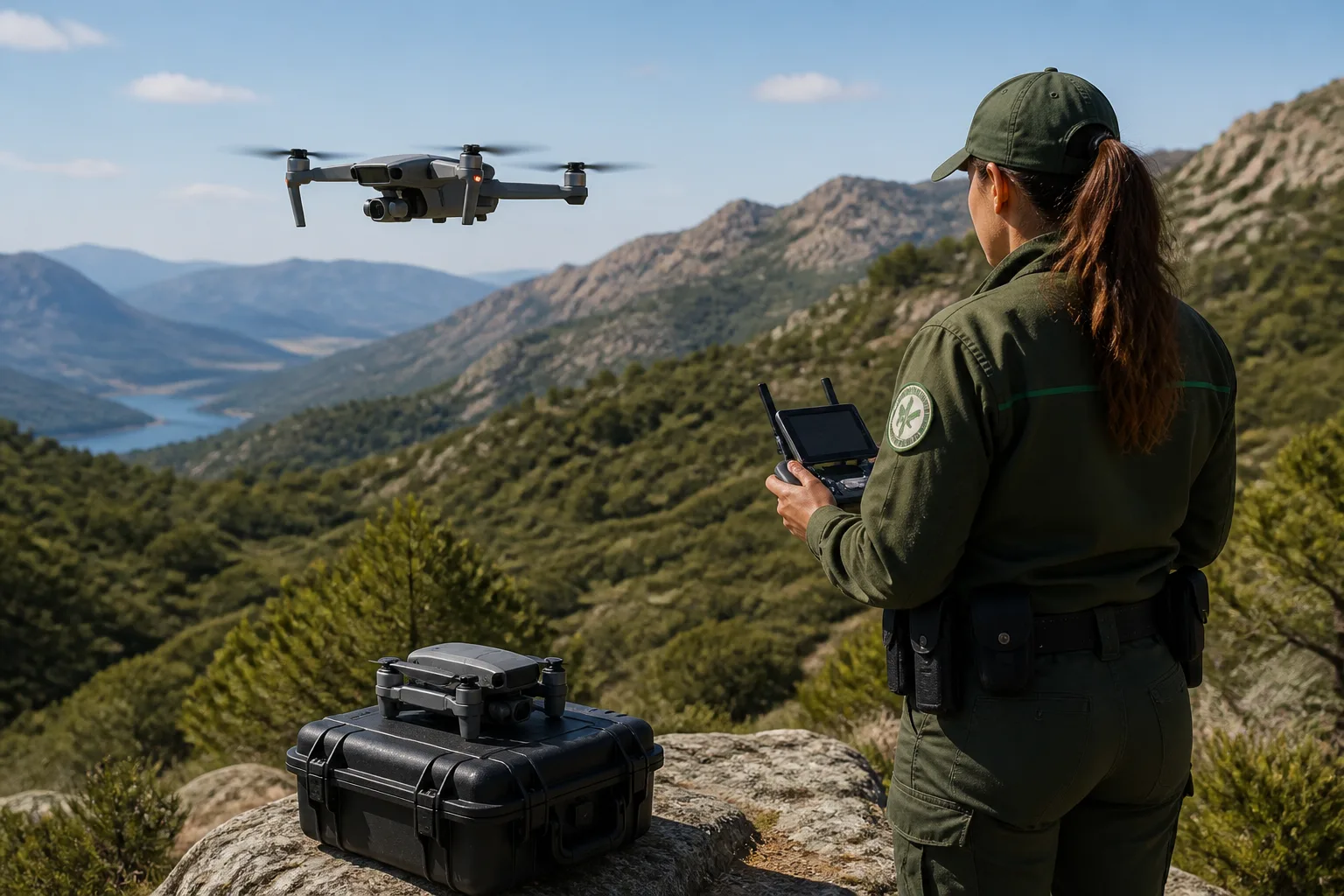
Andalusia’s Minister for Sustainability and the Environment, Fina Martínez, presented 12 drones for environmental agents at a meeting with the service’s coordinators. The €17,500 investment brings the fleet to 41 aircraft to support monitoring, inspection and conservation of natural heritage, as well as forest-fire prevention and investigation. The new equipment will be distributed among the region’s eight provinces, the Doñana, Sierra Nevada and Sierra de las Nieves natural areas, and the regional coordination office. The service has around 90 drone pilots.
The drones can provide aerial images and documentation to help agents plan inspections and work in hard-to-reach places. They may also support analysis of areas affected by forest fires, including terrain, access routes and surrounding conditions. Their use supplements, rather than replaces, on-the-ground checks. Other potential uses include inspecting construction, earthmoving and forestry work; identifying possible dumping or unauthorized activity; and gathering information for wildlife censuses. In conservation work, drones can help locate and monitor breeding areas of threatened species, such as the Montagu’s harrier, and provide an initial view of difficult-to-access sites before specialists carry out work at height.
The meeting also covered changes to the organization, equipment and working methods of the service. Participants discussed the new Andalusian Law on Environmental Agents, which establishes a comprehensive regional framework for their duties and organization, and the ongoing digitalization process. The law defines four corps—Senior, Executive, Technical and Operational—with differentiated responsibilities spanning planning, management, technical support and basic service tasks.
The GAVIS application, for managing environmental monitoring and inspection activities, enables agents to prepare records and reports at the location of an operation. Its phased introduction during 2025 and 2026 has been accompanied by the distribution of 550 tablets across the provinces and natural areas. The ministry is working to address reported issues and add improvements, including connections to other corporate platforms and the integration of maps and cartography.
The ministry is also processing a contract to supply 290 vehicles, with an estimated value of €18.6 million. The plan is to replace the leased fleet in stages through annual deliveries up to 2031. Preparations are also under way for a framework agreement to supply uniforms and personal protective equipment.
A pilot this year is testing provincial communications centers to coordinate agents’ response to emergencies. The aim is to unify their activation before integrating them into the 112 emergency system, as provided for by law. The process is intended to be completed during 2027, before the next high-risk forest-fire period.