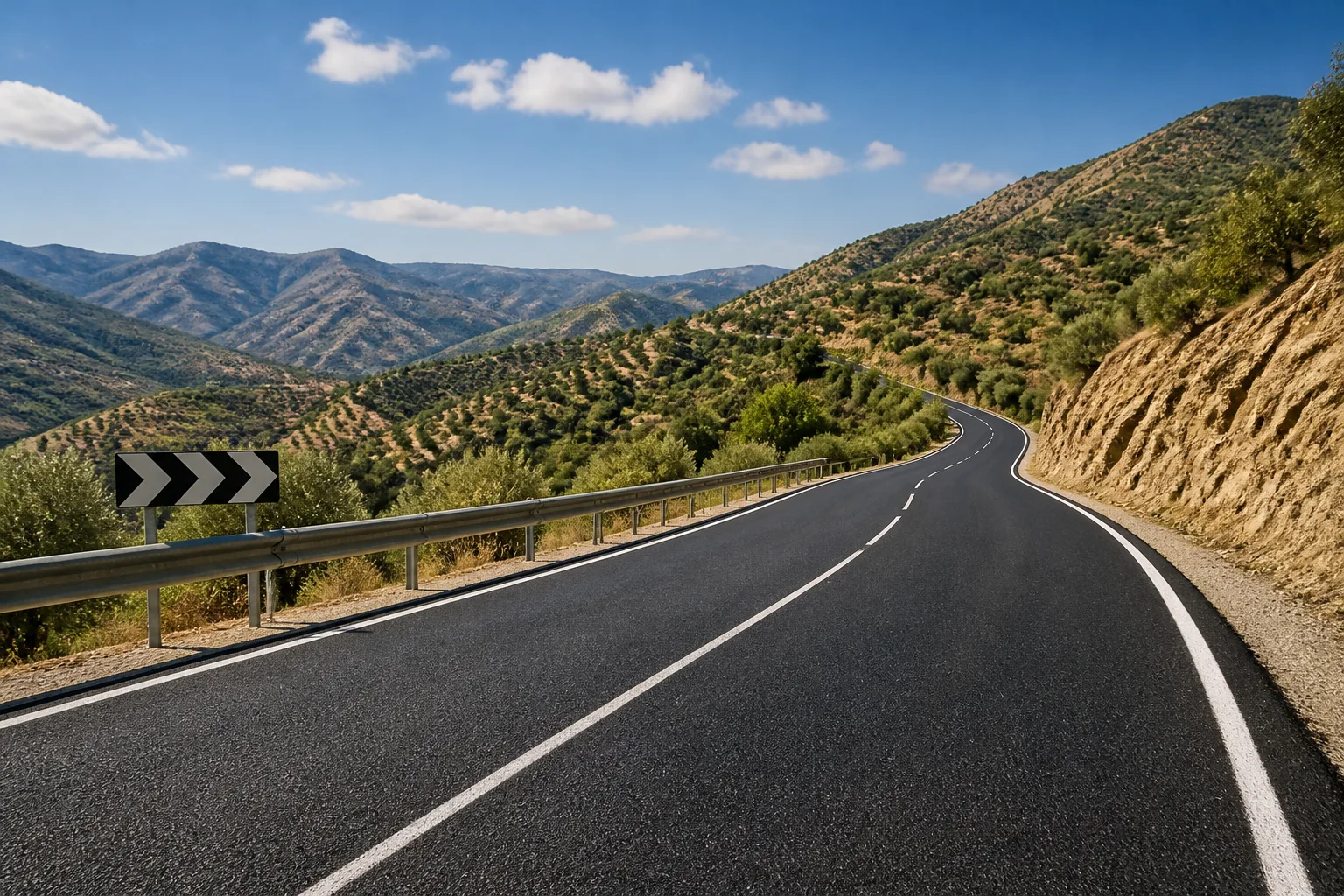
The Andalusian regional government has launched an extraordinary resurfacing plan covering 1,000 kilometres of pavement on 137 roads under its responsibility. Regional Minister for Public Works and Mobility Mario Muñoz-Atanet said the €151.5 million programme was the largest investment in road-surface improvements on the autonomous network in 20 years. The allocation is 17 times the value of ordinary resurfacing contracts, he said.
Muñoz-Atanet said the plan was already under way, with work in progress in Andalusia’s provinces. It covers motorways and conventional roads, with interventions prioritised according to pavement condition. Works began in early summer and are expected to continue until the final quarter of the year.
The contracts cover all eight provinces. Most are allocated €17.5 million, while Cádiz is to receive €22.5 million and Seville €24 million. The minister said the A-92 is among the main routes being resurfaced, with work planned on more than 126 kilometres across sections in Almería, Granada, Málaga and Seville. Night work has started between La Puebla de Cazalla and Osuna in Seville province, and on the A-92 Norte at Gor in Granada. The works add to earlier resurfacing on 87 kilometres of the A-92 using MASAI sustainable asphalt.
Other examples cited by the minister include the A-381 Jerez–Los Barrios motorway, the Huelva–Punta Umbría motorway, the A-357 Guadalhorce motorway on the approach to Málaga, the A-331 between Lucena and Iznájar in Córdoba, and the A-319 in Jaén, which connects municipalities around the Sierra de Cazorla Natural Park.
Work already carried out or under way also includes the A-1178 between Bacares, Gérgal and Olula del Río in Almería; the A-382 at Arcos de la Frontera in Cádiz; the A-385 between Alhendín and La Malahá in Granada; the A-461, A-476, A-479 and A-495 in Huelva province; and the A-316 between Alcaudete and Jaén.
The programme aims to restore deteriorated road sections and maintain appropriate safety and comfort for road users. Planned work includes repairing potholes and soft spots, milling and replacing pavement, restoring the roadbed and lower pavement layers, laying asphalt mixes, sealing surfaces, repainting road markings, and repairing or raising safety barriers. It also includes replacing existing road delineators, expansion joints on structures and traffic-counting loops.
The minister said that in 2019 specific pavement-renewal contracts had disappeared and work was largely limited to patching. The regional government allocated €24 million to pavement improvements in 2025 before launching the extraordinary plan. Other road-network investments announced for this year include €10 million for bridges and structures, €14 million for signage and safety barriers, and €22 million for a new vegetation-control contract. The government’s figures put investment in the regional road network at €355 million in 2015–2018, €509 million in 2019–2022, and a projected €832 million for 2023–2026.