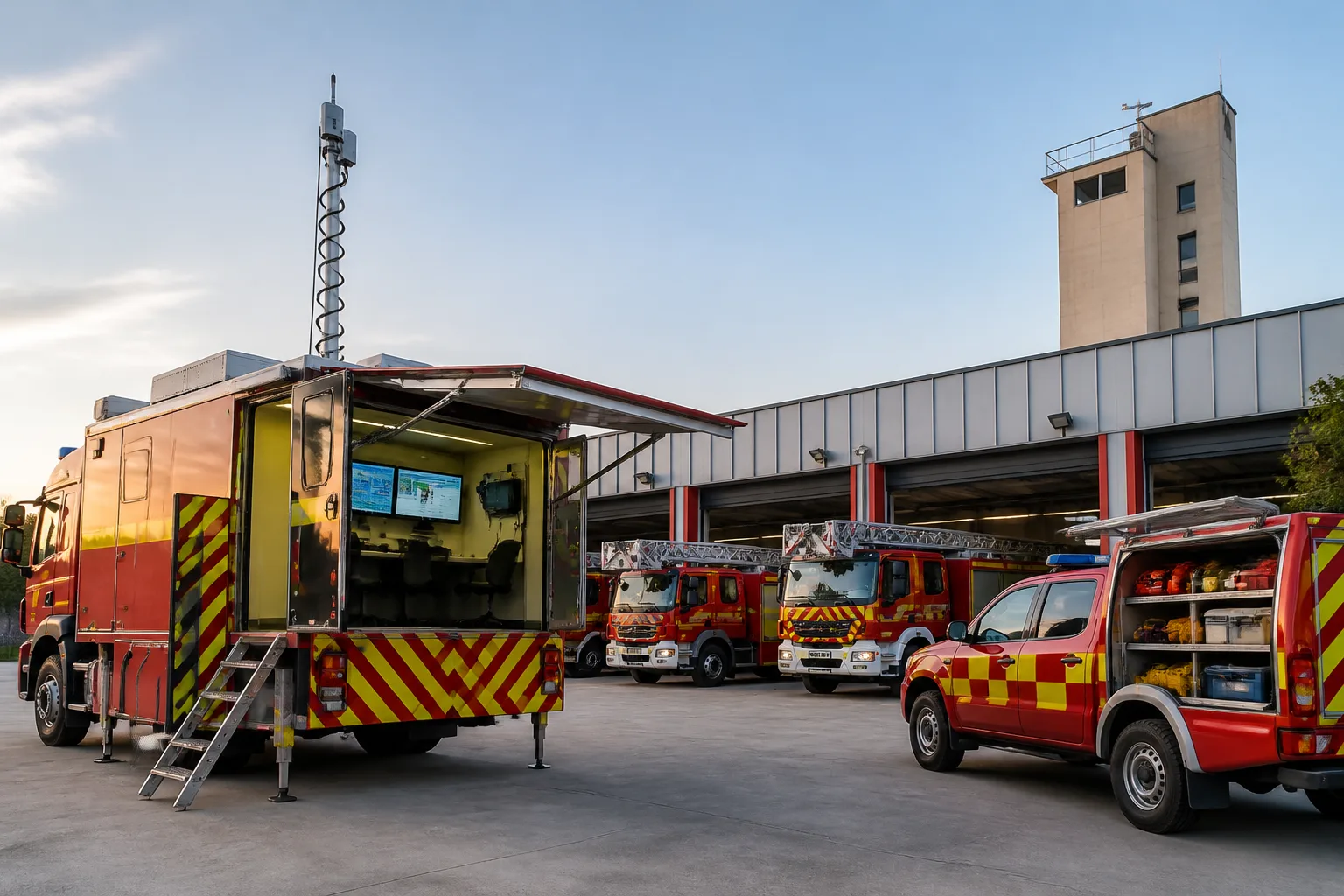
Andalusia’s new draft decree on the coordination, organisation and operation of fire prevention, firefighting and rescue services is expected to be ready in the first months of 2027, regional government vice-president and minister for the presidency, health and emergencies Antonio Sanz announced on July 31, 2026. He made the announcement at the presentation of new vehicles for the Málaga Provincial Fire Consortium, alongside Málaga Provincial Council president Francisco Salado and the Junta’s representative in Málaga, Patricia Navarro.
The vehicles include an advanced command post intended to improve coordination during major emergencies, and a new Logistics Unit for Emergencies and Floods to strengthen the consortium’s operational capacity.
Sanz said the decree would complete a regulatory process begun in 2019. The first step was Law 2/2023, which amended Andalusia’s Emergency Management Law and set out professional grades, categories and duties for fire and rescue services. Decree 36/2025 then regulated open recruitment, internal promotion, mobility, secondment, alternative duties and training. The new draft will address services’ day-to-day operations, including their organisation and functions, fire-station planning, required resources and coordination of responses.
The decree would establish common foundations for regulations governing Andalusian services. Municipalities, provincial councils and consortia would retain ownership and management of their services, while the Junta would coordinate them and set a shared framework, respecting local autonomy.
The proposed rules include continuous, on-site service 24 hours a day, 365 days a year. Fire stations would also be required to maintain independent operational capacity for at least 72 hours during an exceptional emergency, with electricity, communications, fuel and water. Territorial planning would take account of an estimated response time of no more than 30 minutes to population centres in each service area. Planning for station locations would consider resident and seasonal populations, area covered, roads, industrial hazards, dangerous-goods transport, the wildland-urban interface and call volume.
The draft would classify incidents by complexity and required resources, provide for the progressive increase of resources and strengthen unified command when multiple services are involved. It would also allow services, through an agreement, to access the 1-1-2 Andalucía technology platform to share information about incidents, deployed resources and the progress of responses.
The proposal would create a single personnel register under the Andalusia Emergency Agency, recording each registered person’s category, training and professional status. It would enable a shared official credential identifying the holder, category, employing administration and status as an authority agent. The text also covers ongoing training during working hours, physical and psychological fitness, workplace safety, legal assistance, uniforms, vehicles, communications and equality between women and men.
Sanz said the draft was developed with professionals, local authorities and their representatives on the Andalusian Fire Council. He also announced that the Junta would soon begin processing a new Andalusian self-protection decree, following approval of the national basic guideline that will serve as its reference. The proposed decree would update planning obligations, improve links between self-protection plans and the public emergency system, and strengthen prevention at centres, establishments, activities and facilities.
Sanz also congratulated the Málaga Provincial Fire Consortium and its staff on the new vehicles. The event was attended by officials from the Junta and provincial council, consortium representatives and staff, as well as representatives of companies involved in the vehicles.