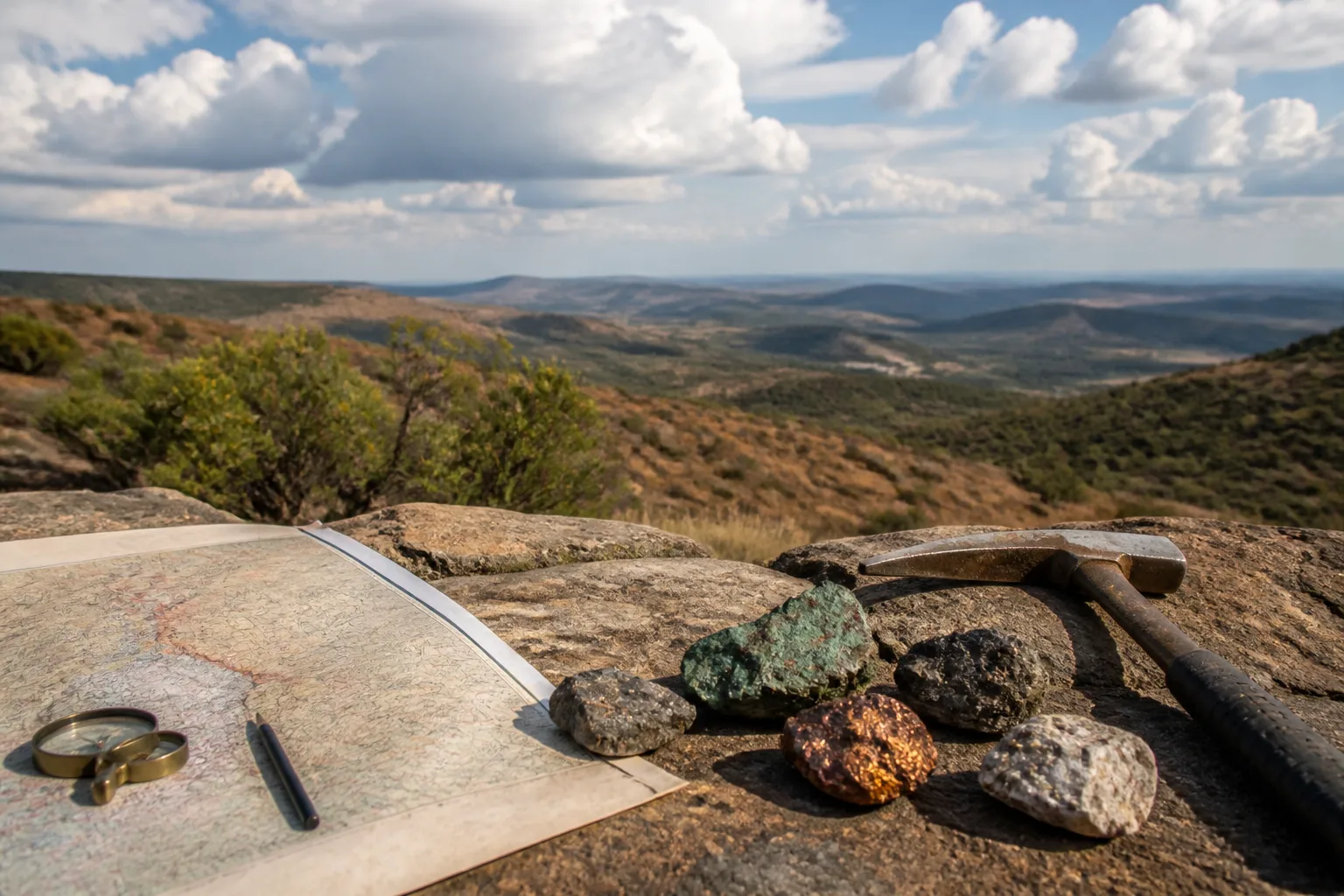
As of August 21, 2026, Andalusia had 73 active mineral exploration permits aimed at locating—and potentially extracting—around 50 substances, including 27 considered strategic by the European Union for industry and the energy transition. The regional government says the work forms part of its 2030 Sustainable Mining Strategy, which seeks to develop the sector under environmental sustainability and legal-certainty standards.
The permits cover 80 municipalities across the eight provinces. Huelva has the most, with 38, followed by Seville with 12; Córdoba with eight; Almería and Jaén with six each; and Cádiz, Granada and Málaga with one each. The distribution reflects the importance of the Iberian Pyrite Belt, one of the world’s largest areas of polymetallic massive sulfide deposits.
Exploration work can include reviewing existing geological information, using geophysical methods such as gravity or magnetic surveys to model the terrain, and drilling to assess potential mineral deposits. The results could, if positive, help turn underground mineral indications into prospects for new mining developments.
The substances under investigation include EU critical raw materials such as copper, magnesium, bismuth and arsenic, as well as lithium, cobalt, nickel and rare earth elements. The regional government says these materials are used in sectors including electrical and electronic manufacturing, transport, steelmaking and pharmaceuticals, and in batteries, energy storage, wind turbines and precision electronics.
Alongside the active permits, the regional Department of University, Industry, Energy and Innovation is promoting exploration in 457 areas linked to expired mining rights. The announcement says public tenders for these rights are being resumed after nearly a decade without calls for tenders in any Andalusian province.
The regional government says Andalusia accounts for about 90% of Spain’s metallic mining value, with annual production exceeding €1.2 billion and 8,000 people employed across 479 active operations. It also reports that authorized production capacity rose by 31.5% during the previous legislature. Projects cited include Masa Valverde, under construction, and an expansion of the Río Tinto project in Huelva, as well as the Los Frailes mine in Seville.
Two projects have been classified as strategic for the EU and received regional incentives: CirCular-Atlantic Copper in Huelva, awarded €7.6 million, and the Cobre Las Cruces polymetallic hydrometallurgical plant, awarded €3.44 million. Regional minister Jorge Paradela said the government’s aim was to support mining projects with technical rigor and legal certainty, while contributing to industrial development and the EU’s strategic autonomy.