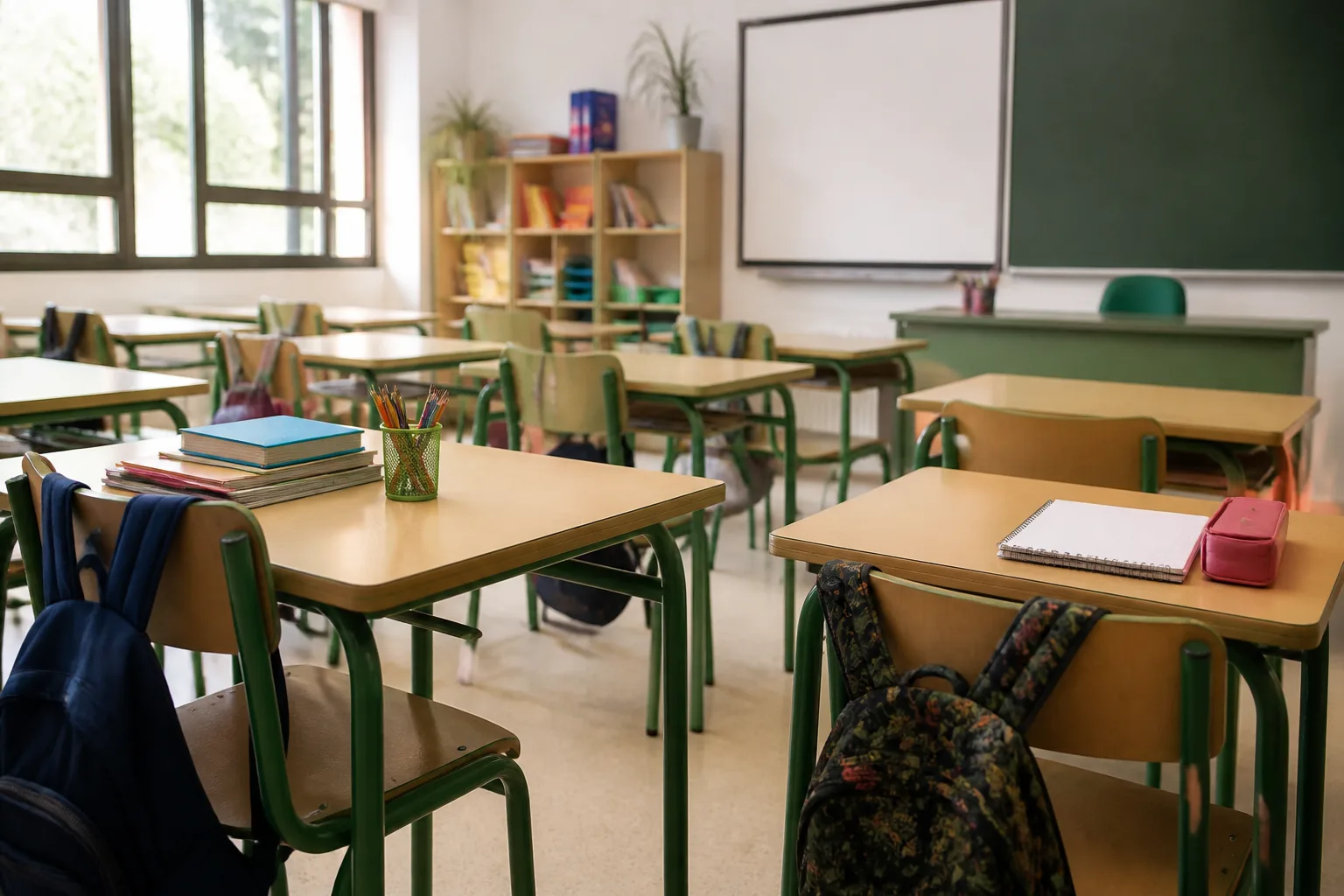
Andalusia’s regional government has outlined key changes for the 2026–27 school year. A total of 1,776,288 students in non-university education will enter classrooms during September at 7,248 public, publicly funded private and private schools, served by 131,525 teachers. Overall, 94.27% of students are enrolled in publicly funded schools: 75.5% (1.34 million) in public schools and 18.7% (333,384) in publicly funded private schools.
The number of students continues to fall amid declining birth rates. Across the second cycle of early-years education, primary, secondary and upper-secondary education, enrolment is down by 30,322 from the previous year—the largest annual decline in the series. Since 2018–19, Andalusia’s education system has lost more than 150,000 students. The regional government says it is increasing staffing despite the decline. Public schools will have 109,128 teachers, 7.7% more than in 2018–19.
The school year began on September 3 for children under three. On September 10, 690,624 students in the second cycle of early-years education, primary education and special education are due to start at 2,735 schools. On September 15, 887,532 students begin secondary education, upper-secondary education, vocational training, adult education, plastic arts and music and dance studies. Language schools and higher arts education—including music, dance, design, cultural heritage conservation and restoration, and dramatic arts—begin on September 21, with 86,738 students.
Public schools will receive 4,309 additional teachers: 2,096 for students with special educational needs and diversity programmes; 1,216 to expand vocational training; 705 for academic support, particularly in mathematics and reading; and 292 for digitalisation. The government puts the investment at €238 million, co-financed by European funds. A further 787 primary teachers and specialists in speech and language and therapeutic pedagogy will join public schools. In the publicly funded private-school network, 209 teachers will be added.
The specialist workforce for supporting diverse learning needs totals 14,916, including counsellors, speech and language teachers, therapeutic pedagogy teachers and social integration technical staff. That is 930 more than last year and nearly 50% more than in 2018–19. Therapeutic pedagogy staffing has risen to 6,735, up 706 from last year; social integration technical staff total 3,812. The government also plans to add 150 social integration technical posts in the civil service.
A new rule sets a maximum of 22 pupils per classroom in early-years education, down from 25, with the change introduced progressively across early-years and primary education, starting with the first year of the second cycle of early-years education. As a result, 234 schools will have new classrooms for three-year-olds this school year. The measure also applies to publicly funded private schools.
The regional government says nearly €1 billion in school-related support will reach more than one million families, averaging €860 per family. Support includes grants, free first-cycle early-years education, discounts for school meals and other services, school transport and free textbooks in compulsory education, which benefit more than 867,000 students. New textbooks are being provided to first- and second-year primary students, and learning materials for students needing specific educational support are being renewed, with a €50 million regional investment.
This year, 494 public schools are undergoing improvements through 551 projects, completed or scheduled for completion by the end of 2026, at a cost of more than €106 million. The works are expected to benefit about 230,000 students. They include three new or replacement school buildings, 27 expansions and 521 renovation, improvement and modernisation projects.