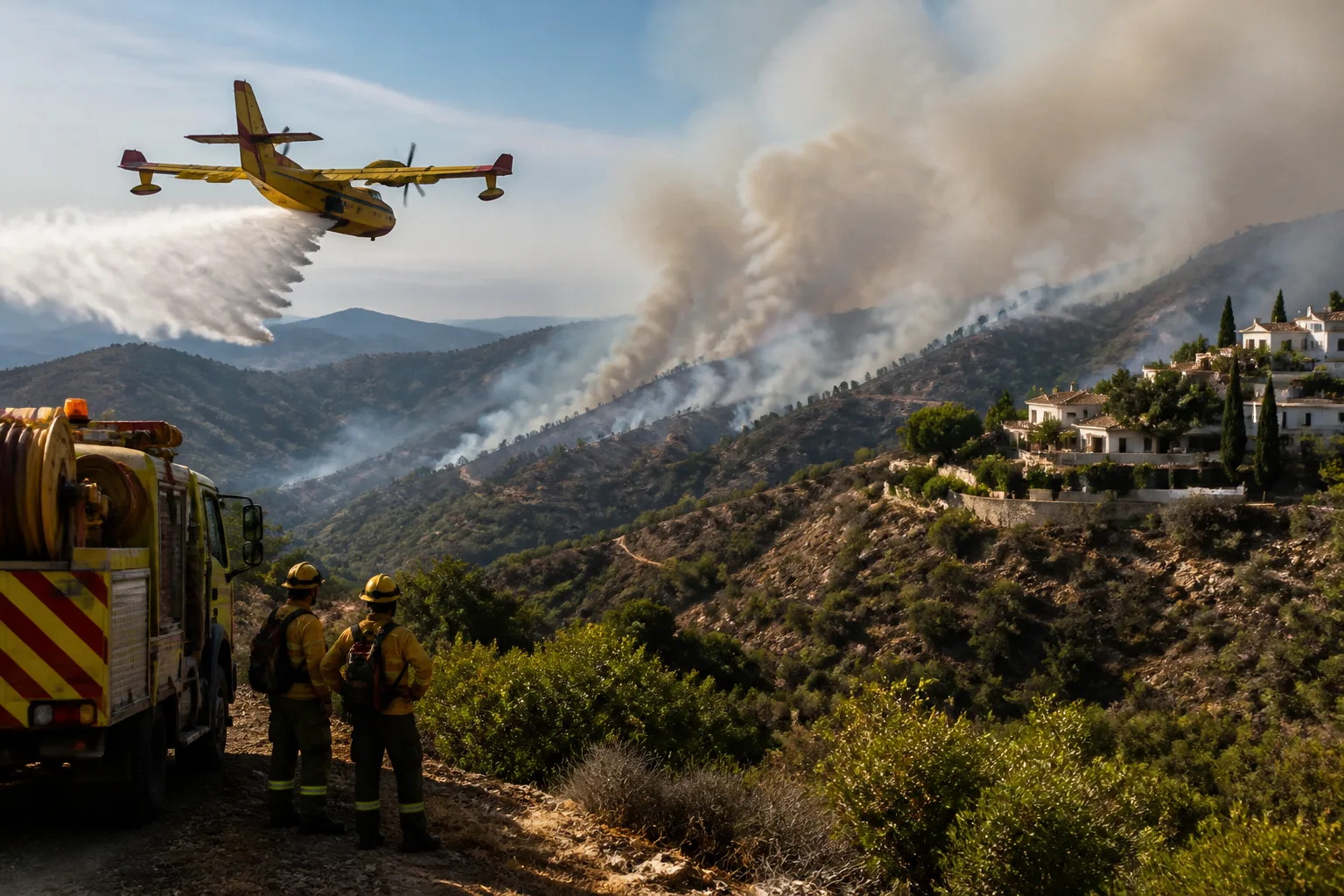
The Andalusian regional government had more than 200 responders and 22 aircraft deployed to fight a wildfire declared on Sunday, 13 September, in Benahavís, Málaga, Vice-President and Minister for the Presidency, Health and Emergencies Antonio Sanz said. The Andalusia Forest Fire Emergency Plan remained in the emergency phase at operational level 1. Sanz said protecting the public had been the priority from the outset.
Preventive confinement remained in place for Benahavís town centre and the La Coja development. Around 50 people from Montemayor, in about 20 homes—mostly second homes—had been moved away as a precaution; they had not needed alternative accommodation.
The 112 emergency service received the first call at 12:37 p.m., reporting a fire near the A-7175 road between the Rosario hermitage and the town centre. As the fire developed, Sanz, in his role as director of the INFOCA plan, raised the emergency to operational level 1 at 1:41 p.m. An Es-Alert message ordering Benahavís residents to shelter in place was sent at 2:34 p.m.
A telecommunications antenna was damaged, causing mobile coverage to be lost in part of the area and possibly preventing some phones from receiving the alert. The warning was also communicated by emergency crews on site and through social media. The issue was reported to the mobile operator to restore service or provide an alternative.
The fire has a long perimeter and is affected by wind and terrain, Sanz said. Conditions had improved between the origin of the fire and the residential developments, although hot spots and small flare-ups remained. The most active area was north of the developments, where crews were working on both flanks and at the head of the fire. Efforts focused on protecting Montemayor, preventing the fire from gaining strength to the north and, if it advanced, directing it toward the perimeter of the 2022 Pujerra fire, where lower fuel loads could reduce its intensity and assist overnight firefighting.
The fire was being driven by wind and topography, spreading along ridgelines and wind-facing slopes. Ravines and drainage basins were making firefighting difficult. Easterly winds of 30 to 35 kilometres per hour, with gusts of up to 50 km/h, had blown during the afternoon. From 10 p.m., winds were forecast to shift slightly to the northeast and ease to 14 km/h, with gusts of up to 25 km/h. Sanz warned that the night would remain active. A coordination meeting was scheduled for 10:30 p.m. to plan overnight operations and assess whether Benahavís residents might be able to return home while remaining under preventive confinement.
Three people received medical attention. A forest firefighter suffered a wrist injury. A 78-year-old man had external burns over 30–35% of his body and was airlifted by medical helicopter to Málaga Regional University Hospital. Another person was treated for mild smoke inhalation and discharged at the scene.
No homes had been affected, Sanz said, although the fire had advanced through developed areas. There was some damage to outdoor features, including fences, terraces and access points. One lane of the A-7175 at the entrance to Benahavís remained closed while crews monitored hot spots and officials considered whether people outside the municipality could return.
The operation comprised 205 personnel, 22 aircraft and two bulldozers. Ground resources included seven forest-fire crews, four BRICA specialist groups, three water tenders and units from emergency services, police, the Guardia Civil and local authorities. The municipality had activated its emergency plan and was assisting vulnerable people and residents needing access to medication. The regional emergency agency urged the public to follow responders’ instructions and stay away from the fire area.