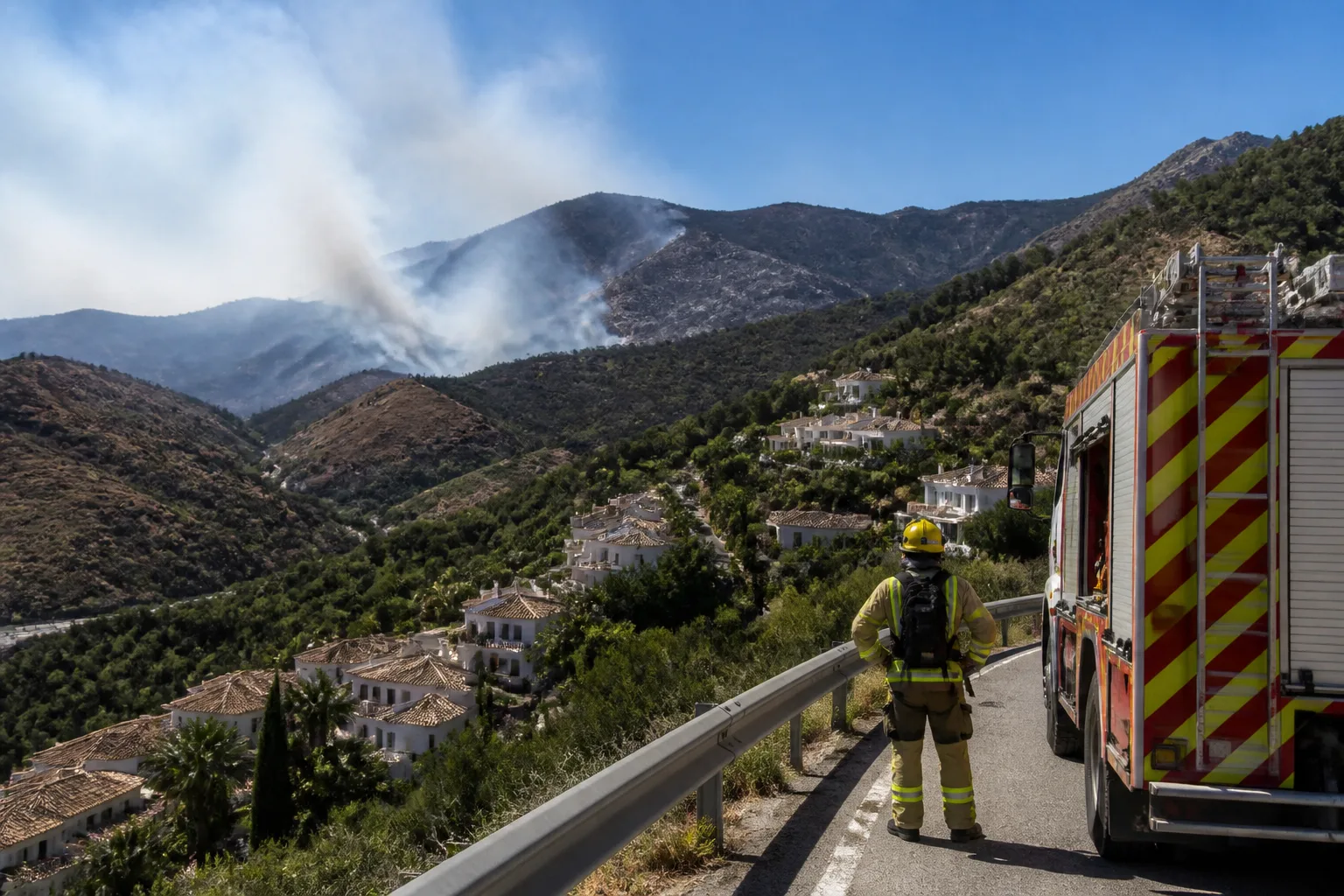
Andalusia’s first vice-president and regional minister for Health, the Presidency and Emergencies, Antonio Sanz, reported that the wildfire declared on Sunday in Benahavís, Málaga, had stabilised. Everyone who had been kept away from their homes was allowed to return, and the Andalusian Forest Fire Emergency Plan (INFOCA) was downgraded.
“We consider the Benahavís fire stabilised and are lowering INFOCA to the pre-emergency phase, operational level 0. All residents can return to their homes and the area is returning to normal,” Sanz said after a meeting of the Operations Committee.
The stabilisation allowed authorities to lift the precautionary evacuation order for the Montemayor and Benahavís Hills developments, as well as for a home known as La Coja. A precautionary confinement order had also been issued for the town centre and scattered settlements of Benahavís. That measure was lifted during the morning as the situation improved.
Sanz said the coordinated work of the emergency services had helped stop the fire’s advance, prevent it spreading across thousands of hectares and protect homes. No damage to houses was reported, despite the risk posed by the fire’s proximity to numerous residential developments.
INFOCA was raised on Sunday to the emergency phase, operational level 1, because the fire could affect residents. The activation strengthened coordination among services and enabled precautionary measures to be taken to protect residents.
Sanz said the fire had been stabilised in just over 24 hours, after a complex response that involved up to 16 aircraft and about 200 personnel. INFOCA and firefighters would continue working until the fire was brought under control and later extinguished.
Although the fire was stabilised, crews remained on the ground to work towards controlling it. The deployment at the time comprised five aircraft and 153 specialists: two light helicopters, one medium-heavy helicopter, one heavy helicopter and one coordination aircraft. Ground crews included 15 forest-firefighting groups, a regional fire reinforcement brigade (BRICA), nine operations technicians, one fire-suppression technician, one environmental officer, an emergency coordinator, a logistics technician, and the director and deputy director of the Provincial Operations Centre. The deployment also included nine water tenders, a mobile meteorology and communications unit, a medical unit for forest fires, a forest-fire maintenance team and two heavy machines.