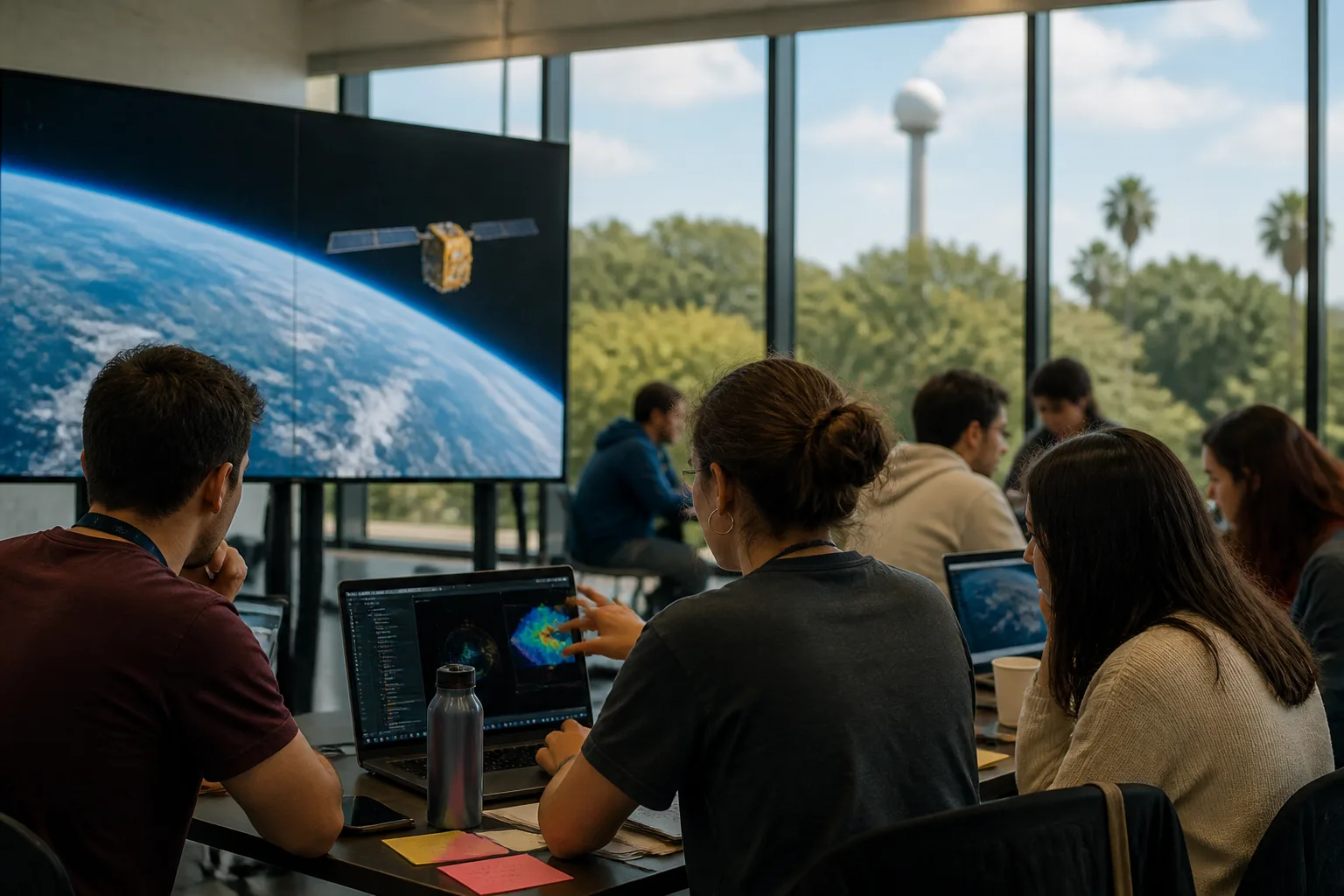
Andalusia’s Regional Ministry of Universities, Industry, Energy and Innovation, through Andalucía Emprende, and the Spanish Space Agency are promoting a new edition of NASA Space Apps Challenge in Seville. Organised by NASA and its partner space agencies, with support from Andalucía Emprende, the event is described as the world’s largest STEAM hackathon.
Students, professionals and people from creative, scientific, technological and entrepreneurial fields will work in teams over the weekend to develop solutions to challenges set by NASA scientists and technologists. They will use science, technology and open data as starting points.
Jorge Paradela, the regional minister for universities, industry, energy and innovation and president of Andalucía Emprende, said the Andalusian government was committed to the aerospace industry, which he described as a sector with strong potential to generate innovation, skilled jobs and economic growth. He said initiatives such as the challenge help bring opportunities in the space economy to young people, professionals and entrepreneurs and encourage talent and new business projects.
Paradela also encouraged students and professionals with an entrepreneurial outlook to take part, saying the event offers an opportunity to apply their skills to real-world challenges, develop innovative solutions and explore opportunities linked to the space economy. He said Andalusia has an increasingly strong and competitive aerospace ecosystem, and that events like this help connect knowledge, businesses and entrepreneurial initiatives.
Juan Carlos Cortés, director of the Spanish Space Agency, said Seville’s return as host, at the agency’s headquarters, showed that the city has talent capable of working with real NASA data. He also emphasised the importance of introducing younger generations to the space sector so they can see it as an area where they can contribute ideas and solutions.
Participants can register through the official NASA Space Apps Challenge website and choose from 14 challenges. Topics include space exploration, Earth observation, the search for exoplanets, artificial intelligence, sustainability, climate research, health and space biology, as well as agriculture, robotics, data visualisation and science communication. Participants may create applications, educational tools, technology prototypes, predictive models or creative projects.
The event will be held simultaneously in six Spanish cities: Seville, Málaga, Barcelona, Bilbao, Madrid and Murcia.
In 2025, the initiative had 114,094 registered participants, who submitted 11,511 projects from 167 countries. Nearly 800 people took part in Spain across the six cities. In Seville, projects focused on satellite data, sustainability and scientific exploration. The local winning team, Dreamcity, made up of students aged 11 and 14 from San Francisco de Paula School, designed a proposal for sustainable future cities combining artificial intelligence and ecological planning. The University of Seville team FyCUS was selected as one of 50 global finalists for a proposal to transform waste recycling on Mars.