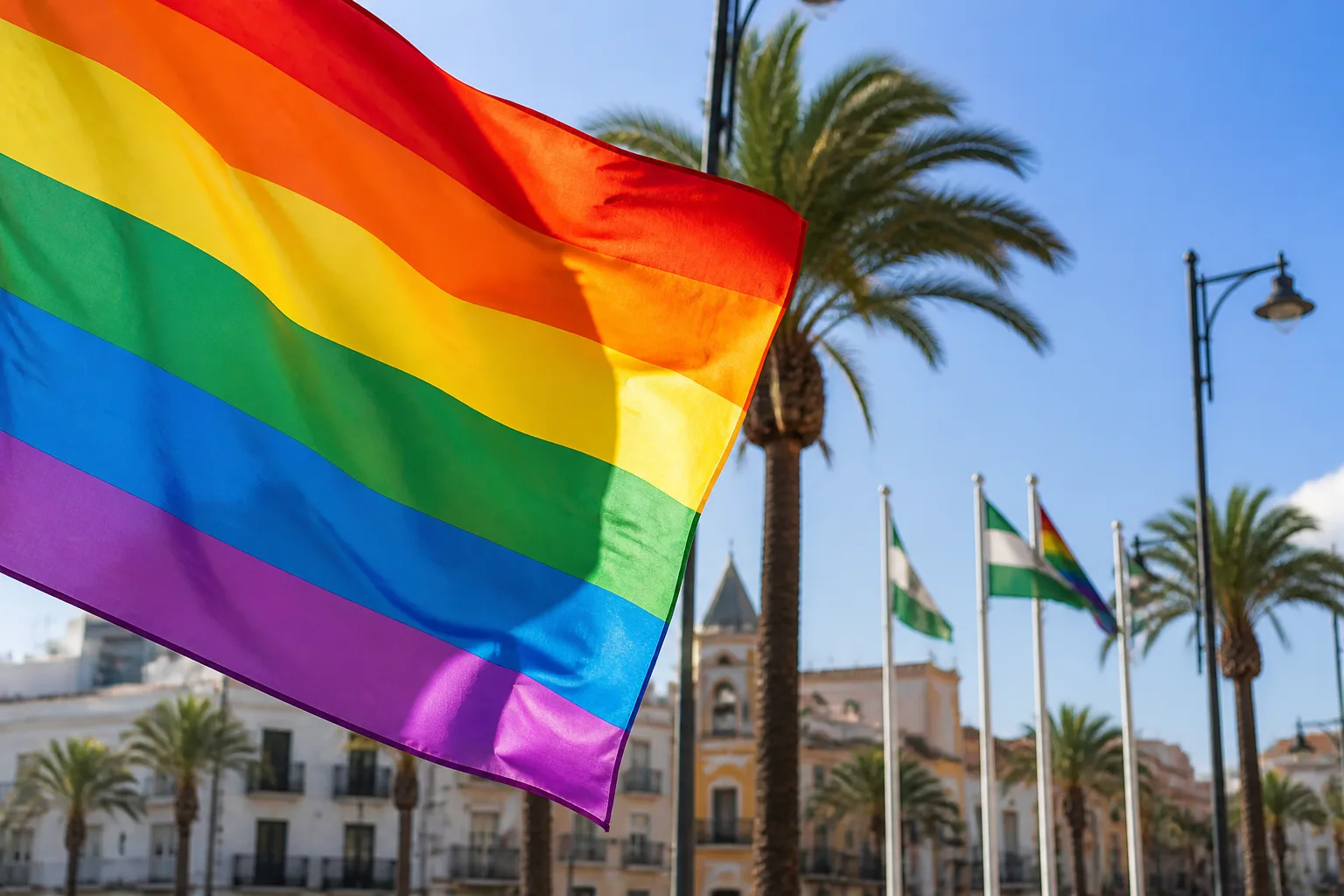
Andalusia’s regional government presented ‘Orgullo Andaluz’, a new network bringing together public administrations, organisations and businesses to support diversity and the rights of LGBTI people. The alliance was announced during the opening of the VI International LGBTI Congress of Andalusia in Torremolinos, Málaga, on 22 September 2026. The congress was scheduled to run through 23 September under the theme “Respect and Diversity: A Red Card for Intolerance.”
Loles López, the regional minister for Social Services, Families and Equality, said the network would encourage cooperation and the sharing of work and resources. It starts with the participation of the city councils of Seville, Jerez de la Frontera, Almería and Torremolinos, and is intended to extend progressively across Andalusia. López said an initial step would be to establish a committee to organise and coordinate the network’s work.
The stated aims include sharing tools, experience and resources to combat LGBTI-phobia and advance rights, as well as exchanging initiatives in research, awareness-raising and events. López called on administrations, organisations and businesses to join, and described unity as an important means of advancing equality and diversity. She also thanked LGBTI organisations and associations for their work and said their efforts help guide public policy.
The congress programme focuses on intersex people, sport, education and the prevention of LGBTI-phobia. López said the sessions would consider education as a means of fostering freedom, respect and equality, and sport as a setting that should be safe and inclusive regardless of sexual orientation or identity. She also said the congress would address calls from the community for greater visibility and protection of the rights of intersex people.
The opening event was attended by Torremolinos councillor for Equality, Education and Youth Francisco García, Director General of Volunteering and Diversity Francisco Obes, and the regional government’s Málaga delegate, Laura Valle, along with representatives of administrations, organisations and groups working on LGBTI rights. García said Torremolinos had been chosen to host the congress again and highlighted the importance of promoting respect, inclusion and acceptance of sexual and gender diversity.
The first day included a keynote address by writer and communicator Mer Gómez, titled “Intersexualities: Bodies Beyond the Sexual Binary,” followed by a discussion on intersex visibility. A panel on sport and inclusion was scheduled for that afternoon, along with the presentation of the new network and a musical performance by singer-songwriter UCEDA.
On 23 September, the programme was set to include a panel on education and efforts to create learning environments free of LGBTI-phobia, followed by a screening of the LGBTI short film ‘Las Moscas del Vinagre’. A session on sexual diversity, gender and public policy was also planned, with a presentation by researcher and UNED doctorate holder María Guadalupe Ñeco Reyna on potential alliances between Mexico and Spain. The congress was organised by the regional Ministry of Social Services, Families and Equality through its Directorate General of Volunteering and Diversity.