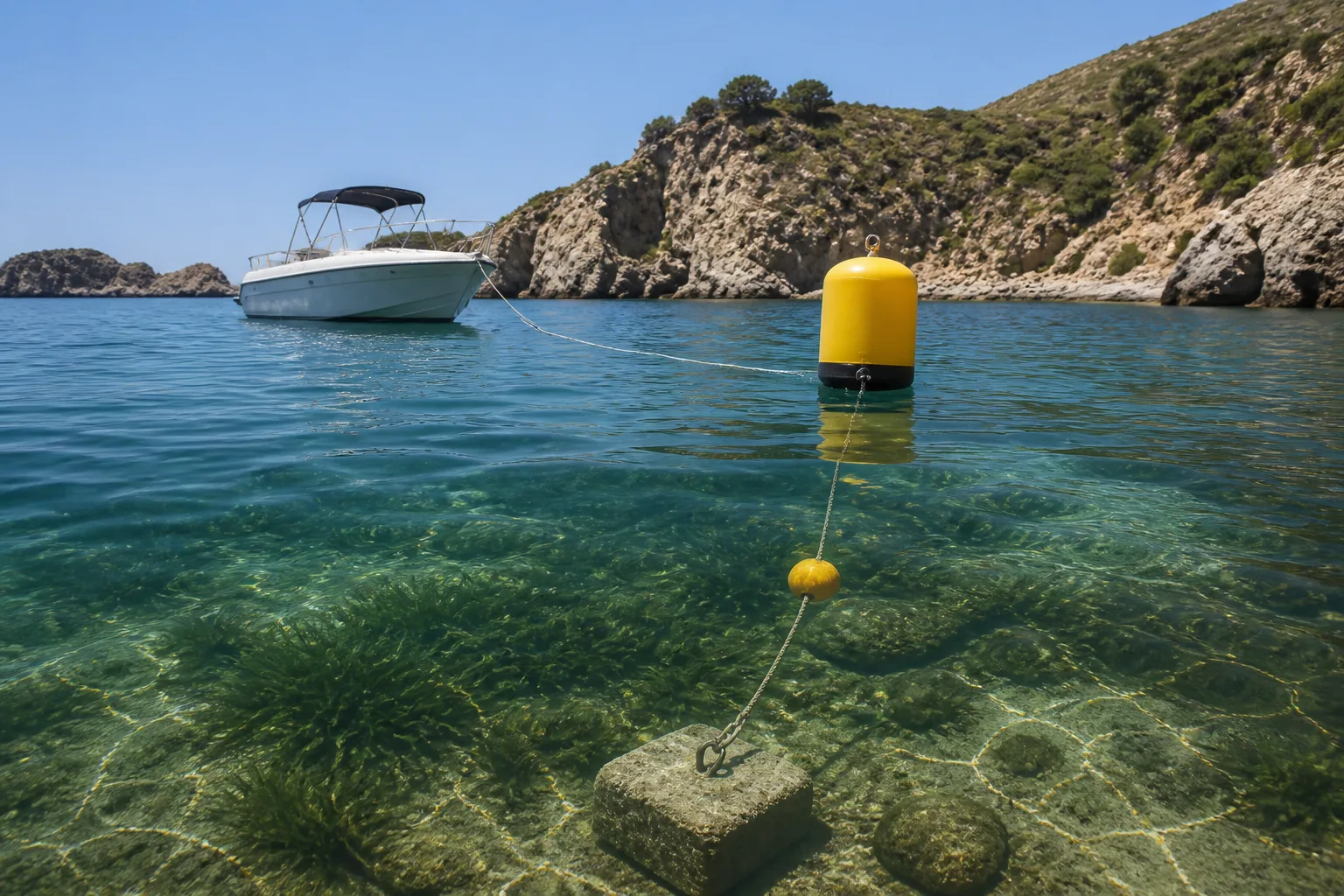
Andalusia’s Regional Ministry of Sustainability and the Environment is installing 25 ecological moorings for boats along the coasts of Granada and Málaga. The structures are intended to provide places for boats to moor without using anchors, which can damage marine ecosystems such as reefs and meadows of oceanic seagrass (Posidonia oceanica).
Eight moorings are planned for the Maro-Cerro Gordo Cliffs Natural Area: three in Nerja, in Málaga province, and five in Almuñécar, in Granada province. Another 10 are planned for the Punta de la Mona Cliffs and Seabeds Special Area of Conservation in Almuñécar, and seven for the Calahonda-Castell de Ferro Cliffs and Seabeds Special Area of Conservation, between the municipalities of Gualchos and Motril in Granada province.
As of the source date, 17 of the 25 moorings had been installed: all eight at Maro-Cerro Gordo, five at Punta de la Mona and four at Calahonda-Castell de Ferro.
The mooring systems vary according to the seabed. On sand, a 5,500-kilogram concrete block reinforced with iron rods anchors the system. It has a stainless-steel ring to which the mooring line is attached. On rocky seabeds, the system is secured with chemical anchors. Both systems include a 32-millimetre rope, a 60-litre buoy marked with the area’s name and basic instructions for use, and a submerged 10-litre buoy. The submerged buoy keeps the line vertical to prevent it from rubbing against, resting on or dragging across the seabed.
The project has a budget of €66,550 and is funded through LIFE IP Intemares, a project coordinated by the Biodiversity Foundation of Spain’s Ministry for the Ecological Transition and the Demographic Challenge. The Junta de Andalucía is the only regional administration taking part. LIFE IP Intemares aims to establish a robust, well-managed system of marine Natura 2000 sites in Spain, supporting effective management of protected areas, scientific research, public participation and awareness campaigns.