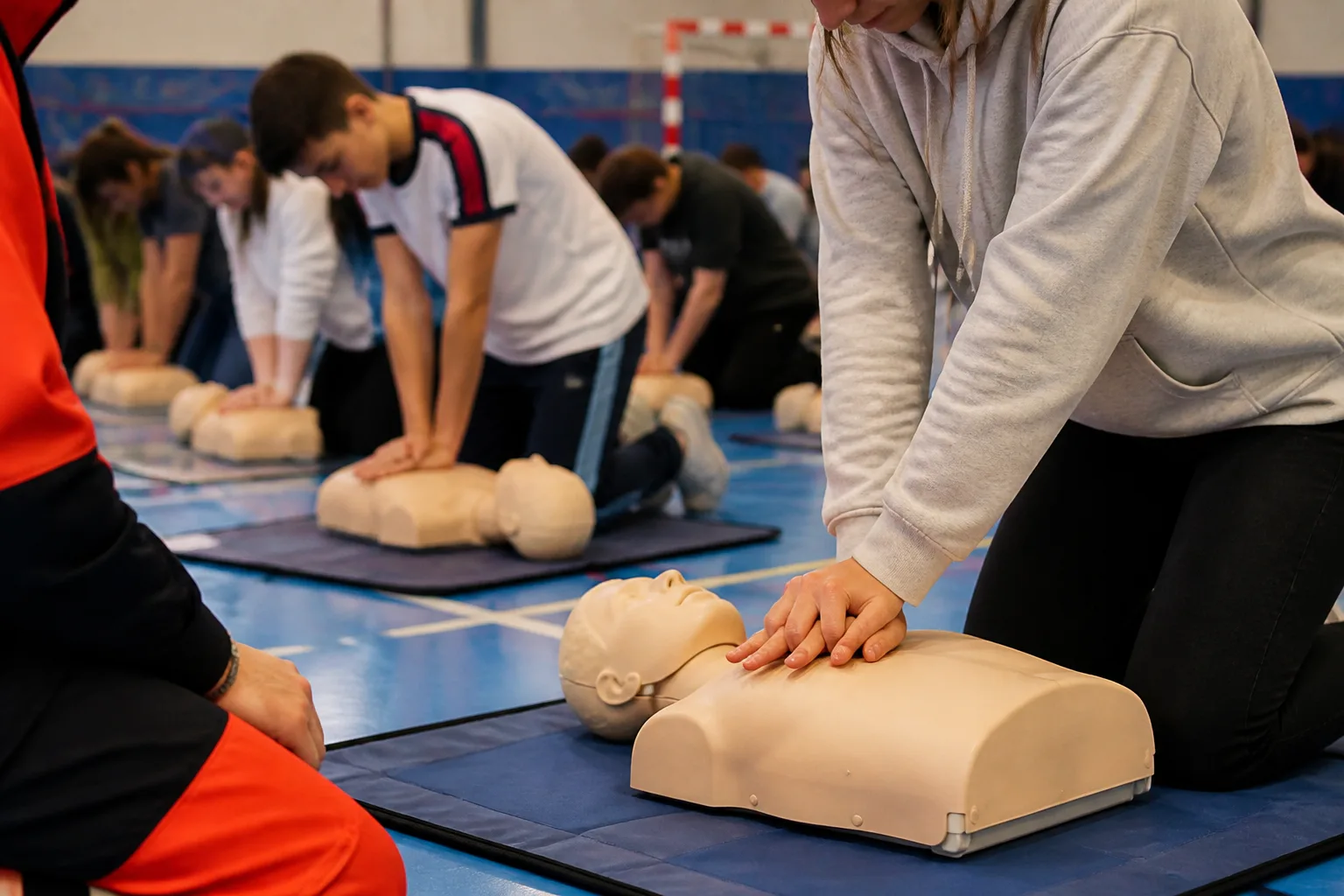
Andalusia’s 061 Emergency Health Centre trained 12,300 young people over two days to respond to cardiac arrest, through eight simultaneous cardiomarathon events held across the region. The sessions were part of the initiative’s 13th edition in most Andalusian provinces. The annual CPR training events have been held since 2013 to mark European Restart a Heart Day, observed on 16 October.
Organised by the 061 Emergency Health Centre, with the cooperation of the regional departments responsible for health and education, the events brought together young people for one-hour practical exercises in every province. More than 100 public and private institutions supported the initiative, with over 300 volunteer instructors taking part. They included healthcare professionals from 061 and the Andalusian Health Service, security and emergency services, the Red Cross, Civil Protection, universities and patient associations.
The events took place on 15 and 16 October at the Mediterranean Games Palace in Almería; the UCO Deporte facility at the Menéndez Pidal Campus of the University of Córdoba; the University of Granada’s corridors; San Andrés Municipal Sports Pavilion in Jaén; Gines Municipal Sports Pavilion in Seville; the University of Málaga Sports Complex; Alto Conquero Secondary School in Huelva; and Francisco Blanca Municipal Sports Centre in Cádiz. The regional delegations for health and education worked with the organisers at each location.
This year, the 061 Emergency Health Centre presented 22 recognitions to people and professionals from security and emergency services whose actions as first responders helped save the lives of 10 patients who suffered cardiac arrest. The awards highlighted the role of the chain of survival, which begins with public assistance.
The release describes cardiac arrest as Spain’s leading cause of premature death and says that it is often cardiac in origin, with sudden cardiac death also affecting young people. It estimates the rate of out-of-hospital cardiac arrest in Andalusia at 19.5 cases per 100,000 residents per year, with more than half occurring at home. The chances of survival depend in part on how quickly basic CPR begins.
During the cardiomarathons, participants practised CPR on manikins or simulated patients and learned the steps in the chain of survival: recognising early that a person is unresponsive and not breathing, and immediately calling 061 for help. Calling on a hands-free phone allows the caller to follow the operator’s instructions and start CPR while emergency teams are on their way.
The release says CPR can be performed using only the hands, with continuous, fast, forceful compressions in the centre of the chest at 100 to 120 per minute. 061 call handlers guide callers through these basic measures until responders arrive. If an automated external defibrillator (AED) is available, it should be used as soon as possible. The release states that using an AED within three minutes while continuing CPR can raise survival chances to above 50%.